# Agentic AI Engineer Interview Questions and Answers
Agent interviews are permission interviews. The candidate who puts the limit in the tool, not the prompt, is the one who has run an agent in production.
11 min read · Advanced · Lesson 6 of 7 in Interviews and careers · Updated 2026-10-03 · By Akash Das
Canonical: https://akash-coded.github.io/aws-bedrock-agentcore-strands/learn/agentic-ai-engineer-interview-questions/
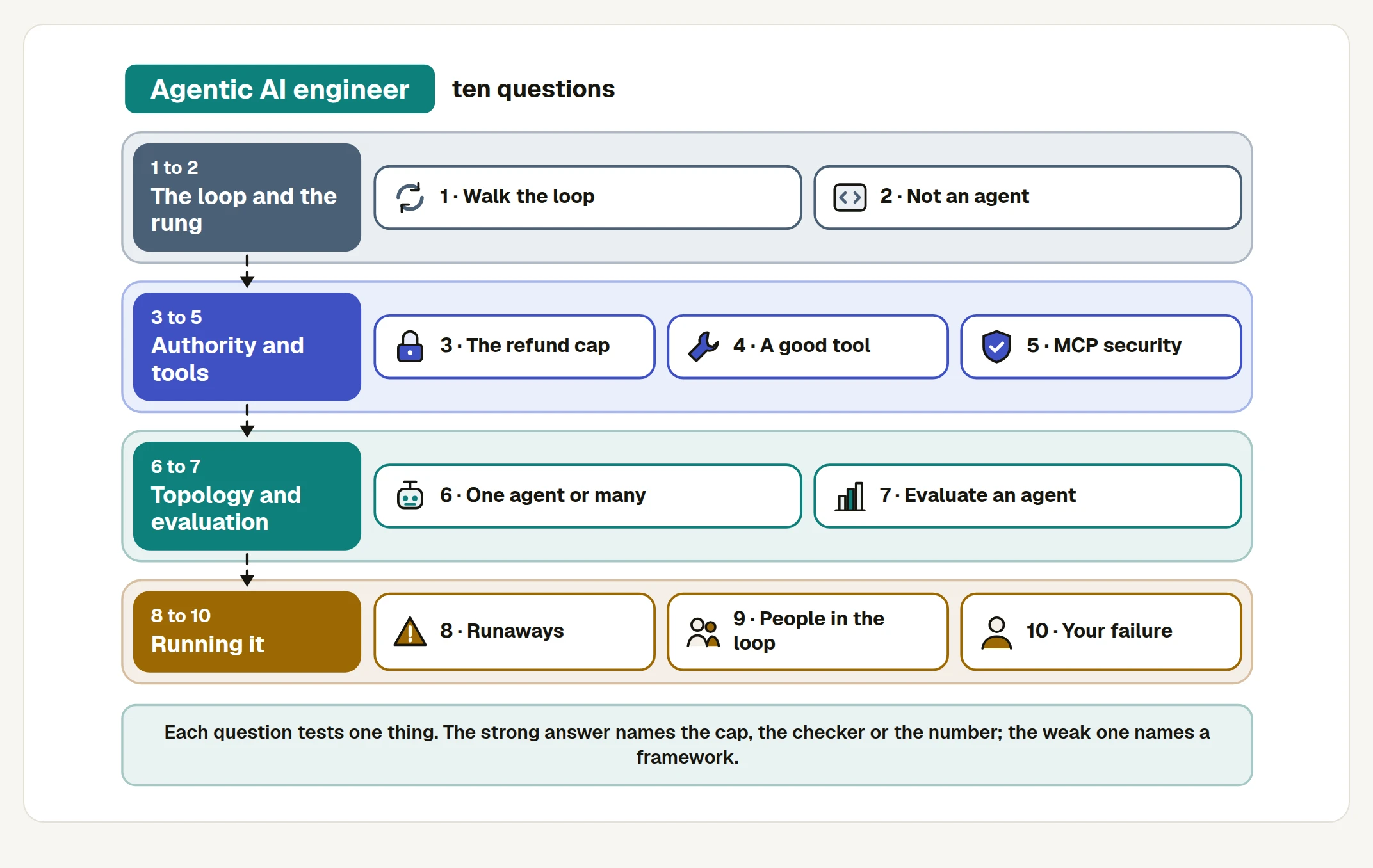
> **In short.** Agentic AI engineer interviews test whether you can run a loop that chooses its own actions without
> letting it choose the wrong ones. These ten questions cover the loop itself, the lowest rung of
> autonomy that works, limits enforced in tools rather than prompts, tools a model can use correctly,
> and the security of what it connects to. They also cover when more agents help, how to evaluate a
> trajectory and how to stop a runaway, and each comes with the framework, a strong answer, the
> follow-up and the red flag.
**In this lesson** you'll practise:
- the loop-level questions that show whether you have built an agent without a framework;
- permission-level questions: the ones that separate prompt thinking from systems thinking;
- evaluation and runaway questions that only production experience answers well.
## Sound familiar?
- You can build an agent in a framework, and could not say what goes in the message list after a tool call.
- Your answer to "the agent must never do X" is a sentence in the system prompt.
- Your multi-agent design has one agent per department.
The questions below are built around those three.
## What does an agentic AI engineer interview test?
**Whether you think in permissions, not prompts.** Expect a coding exercise around a tool-calling loop
(sometimes a broken one to debug), a system design for an agent that takes real actions, and detailed questions on
failures you have seen. Interviewers listen for three things: caps in code, evaluation of the path as well
as the answer, and a stop rule for anything that loops.
## The loop and the rung
### Q1 · "Walk me through the agent loop, message by message."
**Tests:** whether you could debug the loop without a framework · **Framework:** call → stop reason →
dispatch → append both turns → call again → stop
What a strong answer covers
- **The call returns a stop reason**: end of turn, a tool request, or a length limit.
- **On a tool request**: append the assistant message with the tool call *verbatim*, run each tool, append
the results as the next user message with the matching tool-use IDs, and call again.
- **Stop on**: end of turn, an iteration cap, or a token or cost budget, and escalate rather than loop.
- **Errors are results**: a failed tool returns an explicit error the model can act on, never an empty value.
- **The insight:** the loop is simple; production is about termination, cost caps and the trace of every step.
**The follow-up:** "What happens if you forget to append the assistant message?" → the model asks for the
same tool again, because from its side it never asked.
**Red flag:** describing the loop only through a framework's abstractions.
What a strong answer covers
- **The control-flow test**: if you can list the steps in advance, it is a workflow, not an agent.
- **The rungs**: a script, a single prompted call, a fixed chain, a tool-choosing agent, a planner, a
self-directed agent. Each rung up adds calls per task, cost and new failure modes.
- **The routing pattern**: send the known majority down a cheap workflow and reserve the agent for the rest.
- **The insight:** chained steps multiply: eight steps each right 90% of the time are right together about
43% of the time, so every step you can make exact code is worth more than a better prompt.
**The follow-up:** "Where does the agent earn its keep, then?" → where the next step genuinely depends on
what the last tool returned.
**Red flag:** "agents are more flexible", with no cost attached.
What a strong answer covers
- **Bound the parameter in code**, and make an over-limit call without a valid token produce an approval
request, never a payment:
```python
@tool
def issue_refund(booking_ref: str, amount: Decimal, approval_token: str | None = None) -> dict:
"""Refund a booking. Up to 400.00 pays at once. Above that,
it pays only with a valid approval token; without one it
opens a request and pays nothing."""
if amount > LIMIT and not approvals.valid(approval_token, booking_ref, amount):
return {"status": "needs_approval", "request": approvals.open(booking_ref, amount)}
return payments.refund(booking_ref, amount, idempotency_key=f"{booking_ref}:{amount}")
```
- **The approval token is minted by the approval system**, bound to the booking and amount, so the model
cannot create or reuse one.
- **Least privilege**: the tool's identity can refund and nothing else.
- **Tests**: within the limit pays; over it returns an approval request; a forged or reused token is refused.
- **The insight:** a rule in a prompt lowers the probability of the action; a rule in the signature removes it.
**The follow-up:** "What about retries?" → the idempotency key makes a retried call safe.
**Red flag:** "add it to the system prompt" or "a guardrail will catch it".
What a strong answer covers
- **Distinctness**: the description says what the tool is *not* for, and which tool to use instead.
- **Sufficiency**: the model can fill every argument from what it has.
- **Failure honesty**: an explicit, actionable error, never an empty result.
- **Idempotency**: safe to call twice, or explicitly guarded.
- **Blast radius**: reversible and narrow by construction.
- **Observability**: the call, its arguments and its result logged against a trace ID.
- **The insight:** the model sees only the name, the description and the schema. When it picks the wrong
tool, the description is usually the bug.
**The follow-up:** "Would you expose a general SQL tool?" → read-only, on a view, with row limits, or
better, a small set of named queries.
**Red flag:** a generic "execute" tool with broad credentials.
What a strong answer covers
- **Least privilege per server and per tool**, with credentials held outside the model's context.
- **Tool outputs are untrusted**: a result can carry instructions, so it is an injection path.
- **Supply chain**: vet third-party servers, pin their versions, review their changes like dependencies.
- **Authentication for remote servers**, and explicit consent for consequential tools.
- **Log every call**, and keep consequential tools behind caps and approvals whatever the server claims.
- **The insight:** connecting a third-party MCP server is closer to installing a dependency with production
credentials than to calling an API. Review it as one.
**The follow-up:** "The server's tool descriptions changed overnight." → descriptions steer the model; treat
a changed description as a code change.
**Red flag:** "MCP handles security."
What a strong answer covers
- **Start with one agent and tools.** Add an agent only for a named limit: a context window that overflows,
parallel work a tool cannot express, or a different permission boundary.
- **Every hand-off re-sends context and loses some**: two specialists typically cost around two times a
single agent, and swarms or critique loops without a stop rule do not stop.
- **Choose the pattern by what you know**: agents as tools when there is a clear manager, a fixed graph when
you can draw the flow, a swarm only with a stop rule and a budget.
- **The insight:** many multi-agent designs mirror the org chart; collapsing them into one agent with a
fan-out tool often improves both accuracy and cost.
**The follow-up:** "When would you collapse it back?" → when the hand-offs cost more than the specialisation
earns, measured per slice.
**Red flag:** "one agent per task type."
What a strong answer covers
- **Outcome**: did the environment end in the right state? Check the state, not the final message.
- **Trajectory**: were the right tools called, in a sensible order, with no forbidden action on the way?
- **Efficiency**: calls, tokens and time per task, including the slow tail.
- **Safety**: refusals where they were required, and no capped action exceeded.
- **Run tasks in a sandbox with seeded state**, as a regression suite on every change.
- **The insight:** an agent can reach the right answer through a forbidden path. Trajectory checks catch what
an answer-only evaluation passes.
**The follow-up:** "End-to-end success is 60% and every step scores 93%." → chained steps multiply. The
picture below shows the same effect at 90% a step: six steps in a row are right 53% of the time. Measure
end to end and remove steps rather than tuning each one.

**Red flag:** grading only the final text.
What a strong answer covers
- **Prevent**: a hard iteration cap, a token and cost budget per task, a circuit breaker on flaky tools,
and an escalation path when a cap is hit.
- **Detect**: repeated calls to the same tool with the same arguments; the distribution of turns per task,
not the average; alerts on the slowest and most expensive tasks.
- **The insight:** the tail pays the bill. A small share of tasks costing fifty times the median can dominate
the invoice while the average looks healthy.
**The follow-up:** "A cap cuts off legitimate long tasks." → route those to a workflow or a person, and raise
the cap only for a named slice with evidence.
**Red flag:** no caps, or only a monthly budget alarm.
What a strong answer covers
- **Approvals only for consequential actions**; everything reversible acts, with a veto window.
- **Show the evidence** (sources, diffs, tool results) so a reviewer can decide in seconds, well.
- **Batch approvals** where the decisions are alike.
- **Measure the reviewers**: approval rate and time per approval. Near-universal approval in seconds is
rubber-stamping, not oversight; seed known-bad cases to check.
- **The insight:** the unit of human review is the action, not the conversation.
**The follow-up:** "Approvals take hours." → remove approvals from reversible actions, and give the rest a
queue with an owner and a service level.
**Red flag:** "a human approves every step."
What a strong answer covers
- **The signal that exposed it**: the answering model, turns per task, an empty tool result, an abstention rate.
- **The root cause**, found in the trace rather than guessed from the prompt.
- **The control you added** (in code, with a test) and the golden cases that now cover it.
- **The insight:** the strongest answers end with something enforced, not something reminded.
**The follow-up:** "How would you have caught it earlier?" → the monitor or test that was missing.
**Red flag:** a fix that is only a prompt edit.
Show the answer
**Remove steps before tuning them.** 0.93 to the seventh power is about 0.60, so the end-to-end rate is
simply the chain multiplying. Every step that can become exact code (parsing a receipt's total, checking a
policy limit, filling a form) goes to code and leaves the chain. Then evaluate the trajectory on the
failures that remain, and put the policy limit in the submission tool's signature so a wrong step cannot
file an over-limit claim.