# Agentic PDLC for Program Managers: Boards, Bolts, Reporting
You do not own a phase. You own the system the phases run in, and the waits between them, which is where agentic programmes lose their weeks.
7 min read · Beginner · Lesson 2 of 9 in By role · Updated 2026-10-02 · By Akash Das
Canonical: https://akash-coded.github.io/aws-bedrock-agentcore-strands/learn/agentic-pdlc-for-program-managers/
> **In short.** In agentic delivery the programme or delivery manager owns the system the
> phases run in rather than any one phase. That system is the evidence board, the daily cadence, the
> log of open decisions with owners and dates, and the review queue. It is also the lead-time items
> started on day one, the conditions (not dates) for each gate, and the two-number report the sponsor
> reads.
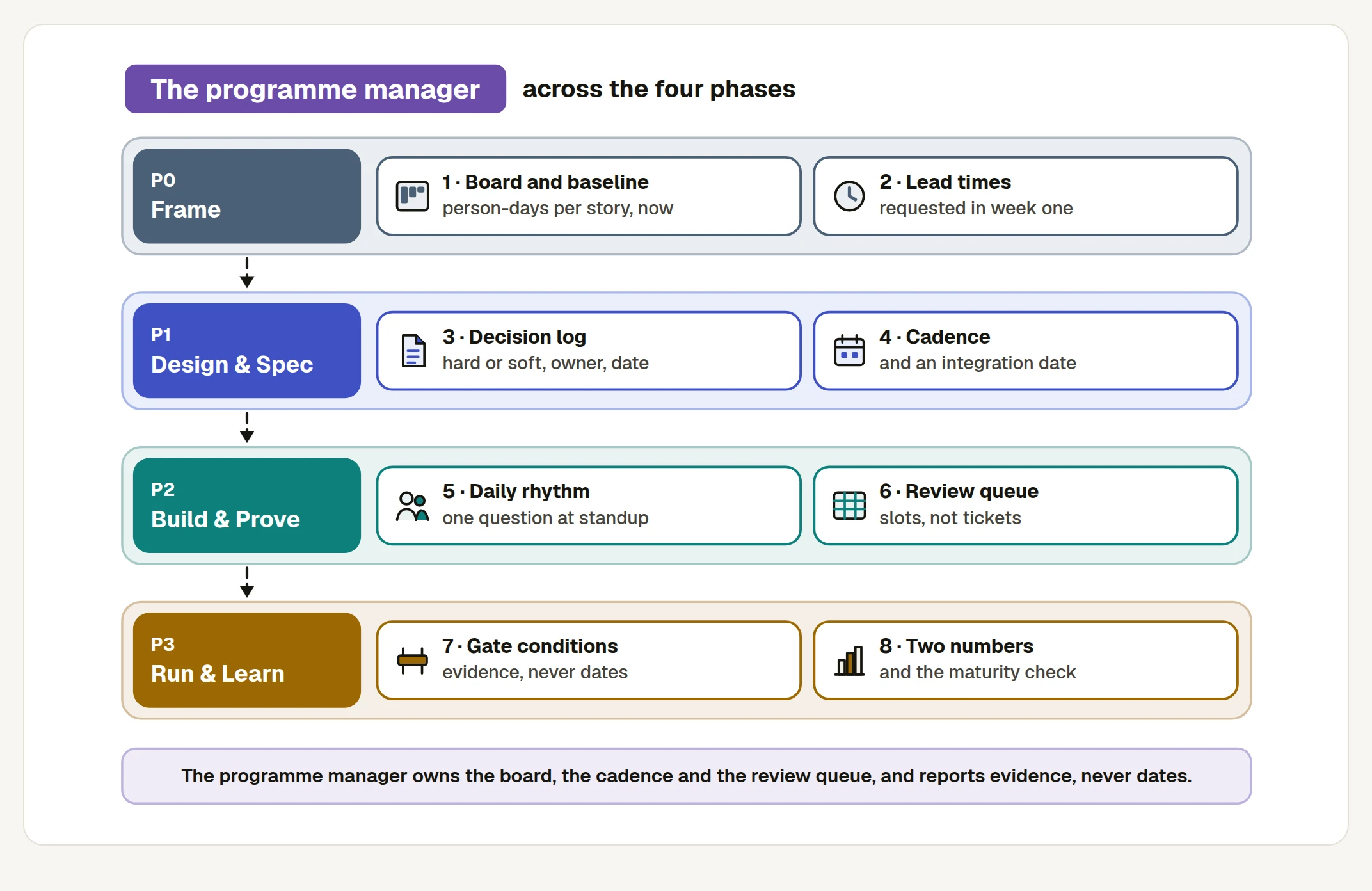
**In this lesson** you'll learn:
- the eight things a programme manager runs across the four phases of agentic delivery;
- how to report progress when "code complete" is roughly the halfway point;
- which decisions are yours to chase and which are never yours to make.
## Sound familiar?
- The status report says green every week, and the launch still slips by a month.
- A decision has been "being discussed" for three weeks, and the build is quietly working around it.
- The plan has a launch date, and nobody has computed how long the canary needs.
In agentic delivery most of the lost time is waits between the phases, not work inside them, and the
waits belong to nobody unless they belong to you.
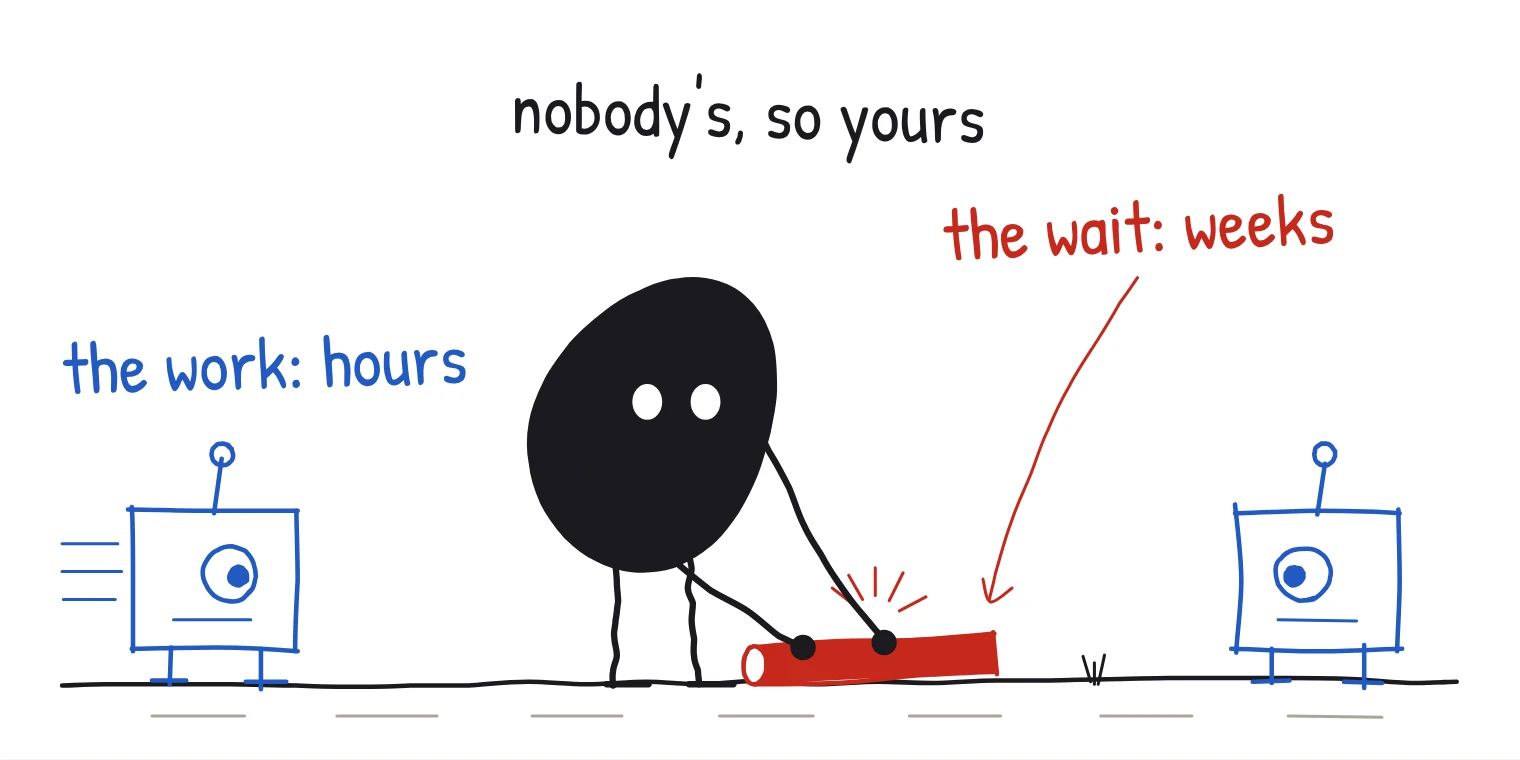
*Agents build a story in hours. The weeks go in the waits between phases, which belong to nobody unless they belong to you.*
## What changes for a programme manager?
**You stop tracking tasks to done, and start tracking evidence to decisions.** When agents build a
story in hours, work is rarely the bottleneck. The waits are: a decision nobody owns, a review queue, an
access request made late, a canary that needs more traffic than the date allows. The role becomes
making those waits visible, owned and short.
## Your eight moves
### P0 · Frame
**1 · Set up the board, and take the baseline.** An evidence board with risk-band swimlanes, and, before
anything changes, person-days per story today. It takes an afternoon and cannot be recovered later.
[The board](https://akash-coded.github.io/aws-bedrock-agentcore-strands/learn/agentic-kanban-board/) **2 · Start the lead-time items.** Model access per model and
per region, data-export approvals, security review: requested in week one, whatever the plan says.
### P1 · Design & Spec
**3 · Run the decision log.** Every open decision, classified hard or soft, each with an owner and a
date; soft ones name their placeholder. A decision with no owner is the most useful thing you can find.
[The hard gate](https://akash-coded.github.io/aws-bedrock-agentcore-strands/learn/the-hard-gate/) **4 · Agree the cadence.** With the product manager and the
architect: how often evidence arrives, usually daily, and the integration deadline that goes with it.
### P2 · Build & Prove
**5 · Run the daily rhythm.** Standup asks two things: did yesterday's bolt integrate, and what is today's
one unknown? The demo is daily, from what merged. [Bolts vs sprints](https://akash-coded.github.io/aws-bedrock-agentcore-strands/learn/bolts-vs-sprints/)
**6 · Watch the review queue.** Count review in slots, not tickets; queue time is slots needed ÷ slots
cleared a day. When it passes two days, the policy is the problem. [Review by risk](https://akash-coded.github.io/aws-bedrock-agentcore-strands/learn/review-ai-generated-code/)
### P3 · Run & Learn
**7 · Schedule gates by condition, not by date.** The shadow window is fixed in advance; each widening
names its evidence; the rollback is rehearsed with a stopwatch before cut-over. Put the evidence days (cases needed ÷ cases per day at the canary share) in the plan. [Cut delivery time](https://akash-coded.github.io/aws-bedrock-agentcore-strands/learn/cut-delivery-time/)
**8 · Assemble the two numbers, and run the maturity check.** The saving beside the spend, with review
hours and re-runs, every cycle; and each quarter, the six-control check with the first missing control
named. [Maturity](https://akash-coded.github.io/aws-bedrock-agentcore-strands/learn/ai-delivery-maturity-model/)
## What is yours, and what is not
| Yours to run | Not yours to make |
| --- | --- |
| The board, the cadence and the daily rhythm | The acceptance bar: the product manager derives it |
| The decision log: owners, dates, placeholders | The decisions themselves: you chase them, their owners make them |
| The review queue and the lead-time items | The risk band of a change: the path rule decides it |
| Gate conditions and the rollback rehearsal on the calendar | Whether a slice has earned wider use: QA's call |
| Assembling the two-number report | Signing it: the sponsor is accountable |
## How to use a model in this role
Let a model assemble the daily note from the merge log and the harness output (what merged, which
slice ran, what it scored) in thirty seconds instead of ten minutes, and draft the weekly report from
the board. Do not let it summarise a decision as made when it is only discussed, or turn a lower bound
into a pass: read every number it reports against its source.
## Where you'll use it
- **In the first week of any agentic programme**: board, baseline, lead-time requests.
- **Every morning**: the two standup questions and the daily demo.
- **Every week and every cycle**: the review queue, the decision log, and the two numbers.
## Why it matters
A status report built on tasks says green while an agentic programme slips, because tasks finish fast
and evidence does not. A report built on evidence (what merged, what is proven, what is waiting on
whom) shows the slip the week it starts, when it is still cheap to fix.
## Try it
Your programme has: a spec signed last week; a framework choice "still being evaluated" with no owner;
model access requested in one region but the data must stay in another; a canary planned at 5% of
300 cases a day with 600 cases needed. **List what you do this week.**
Show the answer
**Four things.** Give the framework decision an owner and a date, and a placeholder (an interface
layer) so the build can proceed. Request model access in the region the data must stay in, today.
Put the canary's length in the plan: 600 ÷ (5% × 300) = **40 days**, and ask whether a wider share is
acceptable for low-risk actions. And confirm the board's Specified column shows the signed spec, bar
and authority budget, so the hard gate is visible as passed.