# AI-DLC vs AIDD vs Agentic SDLC vs PDLC: What Each Term Means
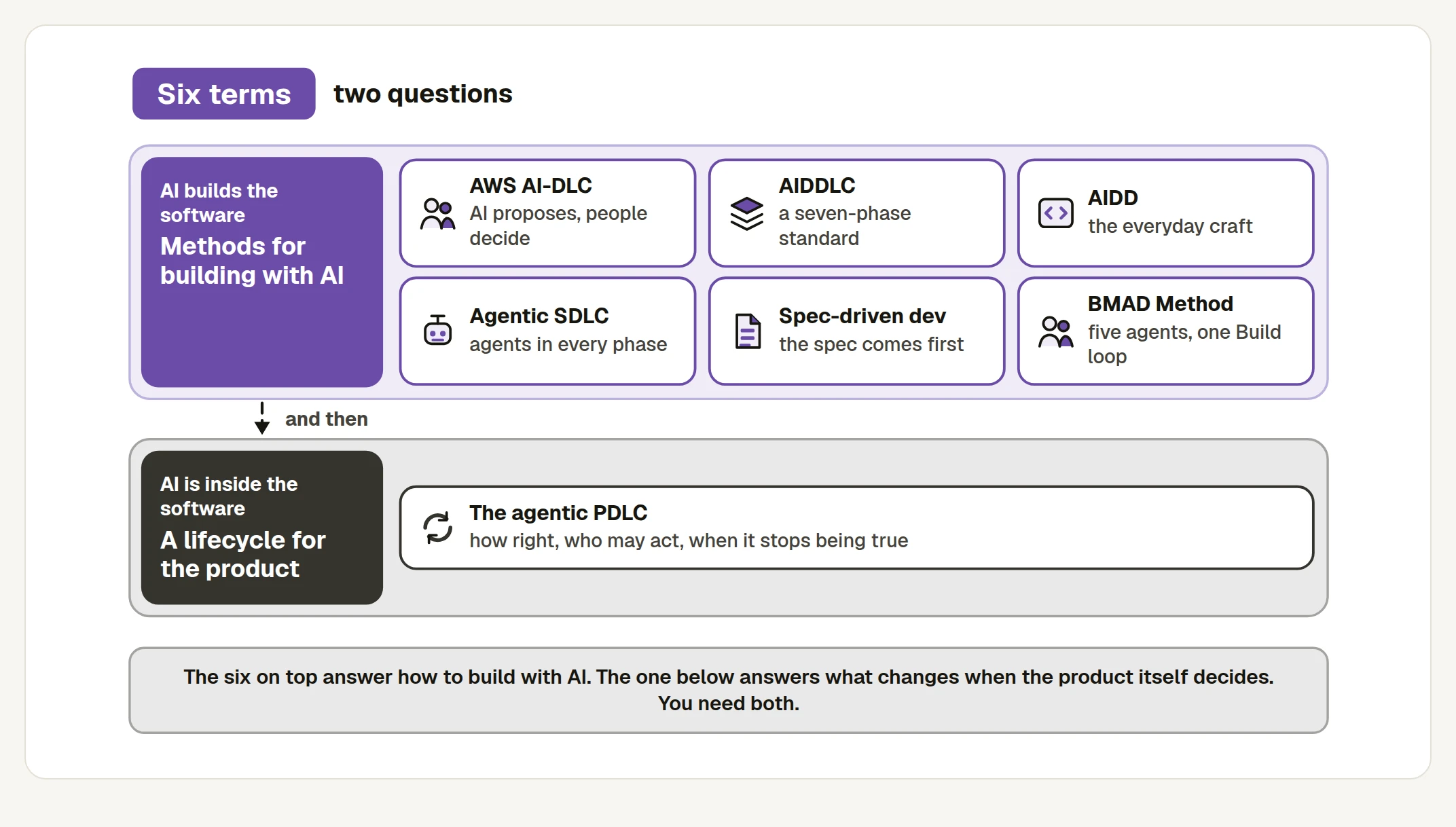
Eight names in two years, several spelled almost the same. One question sorts them: is AI building the software, or is AI inside it?
8 min read · Beginner · Lesson 1 of 7 in Methods decoded · Updated 2026-10-03 · By Akash Das
Canonical: https://akash-coded.github.io/aws-bedrock-agentcore-strands/learn/ai-dlc-vs-aidd-vs-agentic-sdlc/
> **In short.** **AI-DLC** is AWS's 2025 methodology in which AI proposes and people decide across Inception,
> Construction and Operations, and **AIDDLC** is a separate seven-phase standard with a near-identical
> name. **AIDD** is the everyday craft of building with AI tools, **agentic SDLC** is a vendor term
> for agents across the software lifecycle, and **spec-driven development** and **BMAD** are ways to
> structure that building. The **agentic PDLC** is a product lifecycle for software that has a model
> *inside* it, which is the one question the others leave open.
**In this lesson** you'll learn:
- who coined each term, and what exactly it names;
- the one question that sorts them: is AI building the software, or is AI inside it?
- which to reach for when, and how they combine rather than compete.
## Sound familiar?
- A vendor deck says "AIDLC", a colleague says "AI-DLC", and a job posting asks for "AIDD", and nobody is sure they mean the same thing.
- You adopted a spec-driven tool, and it still had no opinion on how accurate the agent had to be.
- Every framework you read explains how to build faster; none says how to tell whether the thing you built is right.
The names are fragmenting faster than the practice. Sorting them by the question each one answers
makes the choice simple.
## What does each term mean?
| Term | Coined or used by | What it names | Answers the question |
| --- | --- | --- | --- |
| **AI-DLC** | AWS: Raja SP, July 2025 | A methodology: AI plans and proposes, people validate and decide, across **Inception, Construction and Operations**, in bolts of hours or days | How do we build software with AI doing most of the work? |
| **AIDDLC** | aiddlc.ai, a separate standard | A seven-phase lifecycle: Foundation, Discovery & Intelligence, Architecture & Design, Specification, Build, Validation, Deploy & Learn (as its site listed them on 3 October 2026) | The same question, with more phases and gates |
| **AIDLC** | Various vendors and writers | Usually a spelling of AI-DLC; sometimes "AI development lifecycle" in general | Depends on the author: check which one they mean |
| **AIDD** | Widely used; no single author | AI-driven development: the everyday craft of building with AI tools (context files, story files, coding agents, review) | How do I work with coding agents day to day? |
| **Agentic SDLC** | Tooling vendors | The software lifecycle with agents taking part in every phase, from planning to operations | Where in delivery can agents act? |
| **Spec-driven development** | Kiro and GitHub Spec Kit, 2025 | Write the spec before the code, and keep it as the artefact agents build from | What should an agent build from? |
| **BMAD Method** | BMad Code | Skills in a coding tool, five named agents and one Build loop; every decision a document | How do we give AI building structure and an audit trail? |
| **Agentic PDLC** | This manual | A four-phase lifecycle, P0 to P3, for products that have a **model inside them** | How right must it be, who may authorise each action, and how will we know when it stops being true? |
## The one question that sorts them
### Step 1 · Ask whether AI is building the software or is inside it
Almost every term above is about **AI as the builder**: a coding agent writes, tests and deploys
code that, once shipped, behaves like any other software. Those methods speed up building.
The agentic PDLC is about **AI as part of the product**: the shipped software itself calls a model to
rank, draft, decide or act. That software is right only a share of the time, fails without an error,
and changes behaviour when the world moves. Building it faster does not answer whether it is right.
### Step 2 · Notice that most real projects are both
A team building a rebooking assistant uses coding agents to write it (AI builds it) and ships a
product that calls a model to rank options and issue refunds (AI is inside it). So the methods are
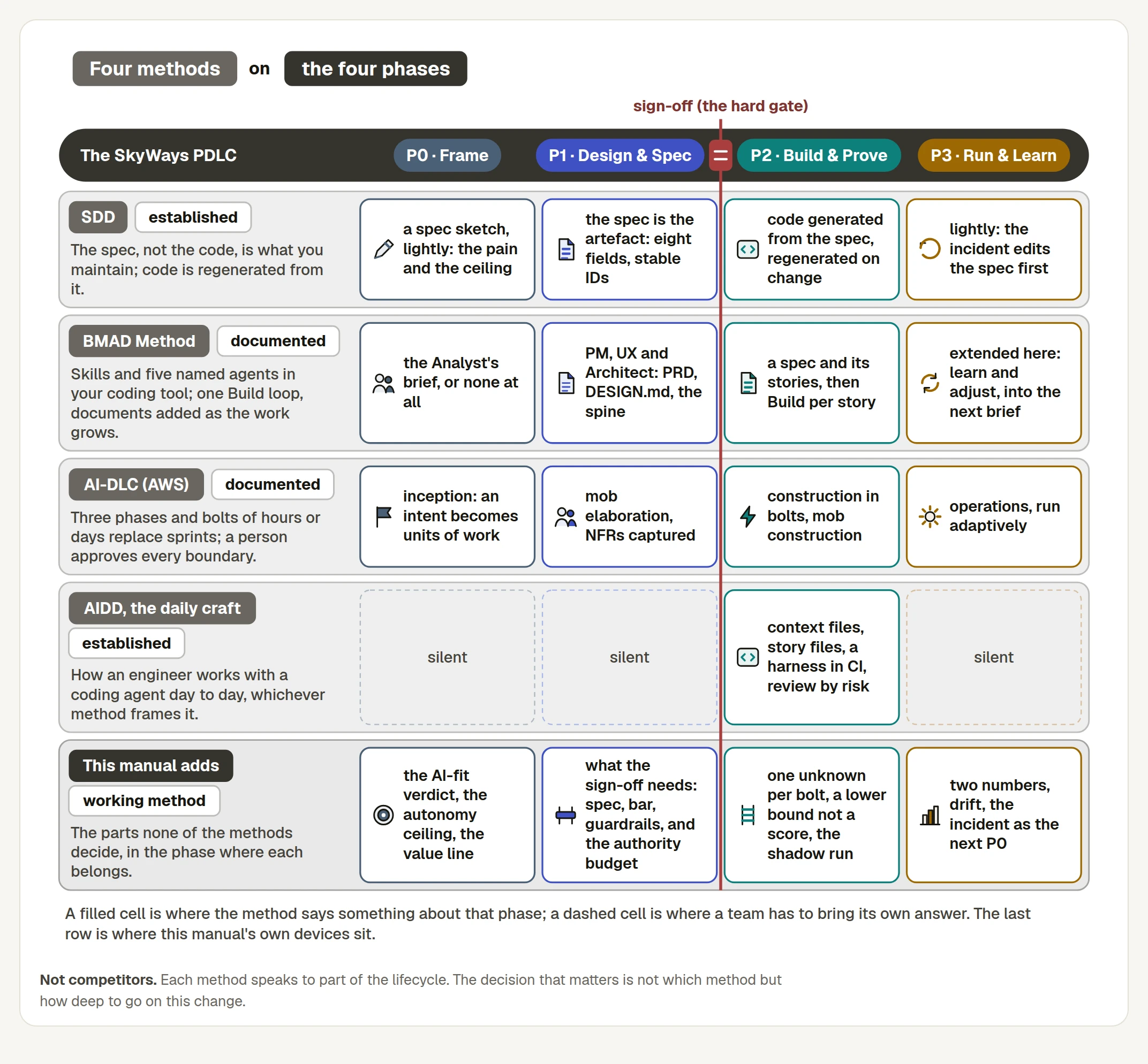
not rivals. AI-DLC or spec-driven development can run the building inside P1 and P2, and the agentic
PDLC supplies what they leave open: the acceptance bar per slice, the authority budget, the shadow
run, the drift watch and the two-number report.
### Step 3 · Pick by the question you are stuck on
- Stuck on **how to structure work with coding agents** → spec-driven development, AI-DLC or BMAD.
- Stuck on **daily habits** (why the agent keeps ignoring conventions) → AIDD's context and story files.
- Stuck on **whether it is good enough to launch, and who decides** → the agentic PDLC.
## Where you'll use it
- **When two people use the same acronym differently.** Ask which question their method answers.
- **When evaluating a tool.** A spec-driven IDE decides where the spec lives, not what its bar is.
- **When writing a job description or a training plan**, so "AIDD" and "AI-DLC" name what you mean.
## Why it matters
A team that thinks it has adopted a lifecycle when it has adopted a building method will ship fast
and discover the missing half in production: no bar, no authority budget, no drift watch. Keeping the
two questions separate is how you notice which half you have.
## Try it
A team says: *"We use Kiro specs and an AI-DLC workflow, so we've got our agentic lifecycle
covered."* Their product is a support agent that issues account credits. **What have they probably
not decided yet?**
Show the answer
**Everything about the model inside the product.** Kiro and AI-DLC structure how the software is
built: requirements, design, tasks, bolts. Neither decides how accurate the credit decisions must be
for each kind of case, which credits need a person to approve, where the credit cap is enforced, how
the agent will be run in shadow before it acts, or how drift in its decisions will be caught. Those
are the agentic PDLC's questions, and they sit alongside the building method rather than replacing it.