# AI Drift: How to Catch the Defect With No Error Message
No code changed, nothing threw, no alert fired, and three months later a customer noticed the assistant offers credits where it used to offer refunds.
6 min read · Intermediate · Lesson 12 of 13 in Running delivery · Updated 2026-10-03 · By Akash Das
Canonical: https://akash-coded.github.io/aws-bedrock-agentcore-strands/learn/ai-drift-monitoring/
> **In short.** Drift is an AI system changing its behaviour with no deploy, no error and no
> alert, because the world, its inputs, its data or the model behind it moved. You catch it by watching
> the **mix of its outputs** against **two thresholds**: the week-on-week change, and the level against
> a frozen baseline. A breach is wired to re-open the release gate on its own.

**In this lesson** you'll learn:
- what causes drift in an AI agent, and why ordinary monitoring never sees it;
- why the output mix beats accuracy as an early signal;
- the two thresholds, and why one is never enough.
## Sound familiar?
- The dashboards are green, the error rate is flat, and the complaints are rising.
- Quality dropped this week and nobody deployed anything.
- The drift alert is set at 5% a week, and it has never fired.
Your existing monitoring answers whether the system is up and fast. It was never looking for this.
## What is AI drift?
A probabilistic system changes behaviour when the world moves. The questions customers ask shift with
the season; a partner changes its rules; the documents the agent retrieves are edited; the provider
updates the model behind an alias; or a failover quietly routes calls to a smaller model. None of these
is a deploy, none raises an error, and all of them change what the agent does.
## Catch it, step by step
### Step 1 · Pin what you can, and log what answered
Pin the model version in each environment's manifest, so an update is a change you make rather than
one that happens to you, and **log which model and prompt version answered every call**, so a failover
shows up in the data rather than in a complaint.
### Step 2 · Choose the output mix to watch
Pick the mix of decisions that matters (refunds versus credits, escalations versus resolutions,
rebookings versus waitlists) and chart it weekly. Watch the **output mix, not the accuracy**: accuracy
needs labels and arrives weeks late, while the mix is visible the same day.
### Step 3 · Set two thresholds, not one
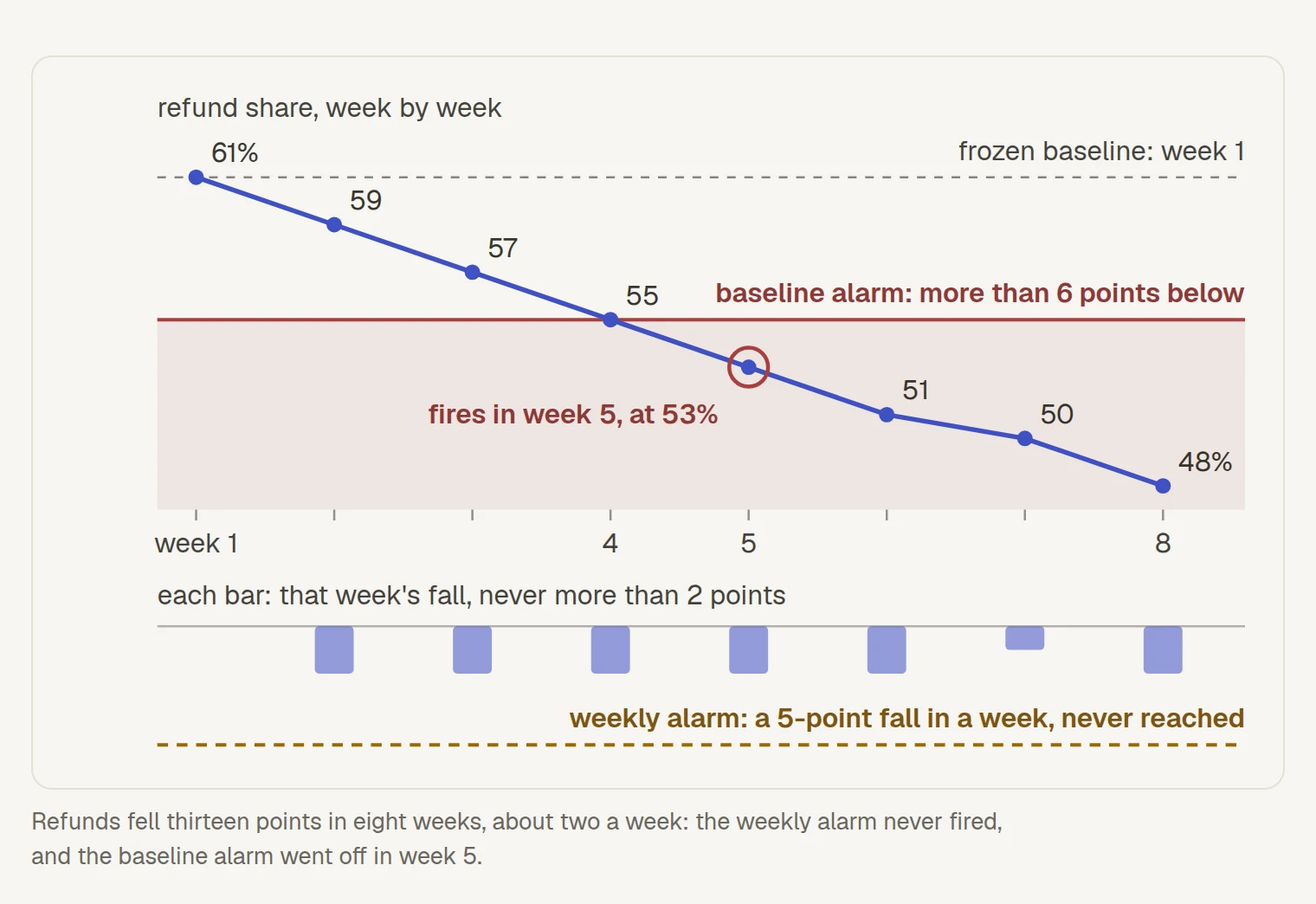
A weekly threshold catches a jump; a baseline threshold catches a slide. At SkyWays the
refund-to-credit mix went from **61/39** in week 1 to **48/52** in week 8, thirteen points: week by week
the refund share read 61, 59, 57, 55, 53, 51, 50 and 48%. No week moved more than 2 points, so a 5%
week-on-week alert never fired; the slide averaged **1.9 points a week**.
A second threshold, on the level against a frozen baseline, catches exactly that. Set it to fire when
the share moves more than 6 points from week 1's 61%, either way: it stays quiet in week 4, at 55%,
exactly 6 points down, and fires in week 5, at 53%. A slide of two points a week never trips a weekly
rule and still moves you twenty-six points in a quarter.
### Step 4 · Wire a breach to the release gate
When either threshold is breached, the [release gate](https://akash-coded.github.io/aws-bedrock-agentcore-strands/learn/ai-governance-gates/) re-opens
automatically: the affected action can drop back to shadow while the cause is found. If re-opening
needs somebody to decide to do it, it will be decided in the next steering meeting.
### Step 5 · Keep a labelled sample, on a schedule
Labels arrive late, but they still arrive. Have people judge a small sample of live cases on a fixed
schedule, per slice, and compare with the golden-set bar. It confirms what the mix suggested and
catches the drift that does not change the mix.
## Where you'll use it
- **From the first day of live traffic**, for every action the agent takes.
- **After any upstream change**: a new model version, a changed data source, a partner's rule change.
- **In the sponsor's report**, as a KPI: the output mix is a business metric, not a technical one.
## Why it matters
Drift is the defect with no error message, so it is found by whoever is looking, and if nobody is,
by a customer, months later. Watching the mix against two thresholds turns a slow, silent slide into
an alert in week 5 instead of a complaint in the third month.
## Try it
A support agent's escalation rate was 20% at launch. Weekly readings since: 20, 21, 22, 23.5, 25, 26%.
The alert fires on a weekly change above 3 points. **Has it fired, and what would have caught it?**
Show the answer
**It has not fired**: the largest weekly change is 1.5 points. But the level has moved from 20% to 26%
in five weeks, a 30% relative rise. A baseline threshold (for example, alert when the level is more than
3 points from the frozen launch baseline) would have fired in week four, at 23.5%. Then check the logs
for what changed: a model version, a data source, or the questions customers are asking.
. Using weeks 1 to 2 as a
frozen baseline, flag every week in which a type's share moved more than points week on week, or
more than points from the baseline. Show a table and the first week each threshold fired.
```
## Sources and credits
| Idea | Origin | Source |
| --- | --- | --- |
| Watch the output mix against two thresholds; drift re-opens the release gate | **Original**: this manual | [QA lead, step 8](https://akash-coded.github.io/aws-bedrock-agentcore-strands/qa/#watch) · [Mental Models](https://github.com/akash-coded/aws-bedrock-agentcore-strands/wiki/Mental-Models#drift-is-the-defect-with-no-error-message) |
| The 5% weekly alert and the 6-point level alert | **Original**: working defaults to tune | [Sources and Confidence](https://github.com/akash-coded/aws-bedrock-agentcore-strands/wiki/Sources-and-Confidence#the-working-methods-and-how-to-tune-each) |
| Pin the model; log which model answered | **Original**: this manual | [Error Index](https://github.com/akash-coded/aws-bedrock-agentcore-strands/wiki/Error-Index#quality-dropped-with-no-deploy) |
| Concept drift, as a field of study | **Borrowed** | Gama, J. et al. (2014). A survey on concept drift adaptation. *ACM Computing Surveys* 46(4) |
| The SkyWays drift | **Illustrative**: a fictional airline | [The workbench](https://akash-coded.github.io/aws-bedrock-agentcore-strands/workbench/#/) |