# AI Governance Gates That Don't Slow Delivery: The Five Gates
A gate is a decision with evidence in front of a named person, not a click, a status column, or a meeting that ends in "fine".
6 min read · Intermediate · Lesson 11 of 13 in Running delivery · Updated 2026-10-02 · By Akash Das
Canonical: https://akash-coded.github.io/aws-bedrock-agentcore-strands/learn/ai-governance-gates/
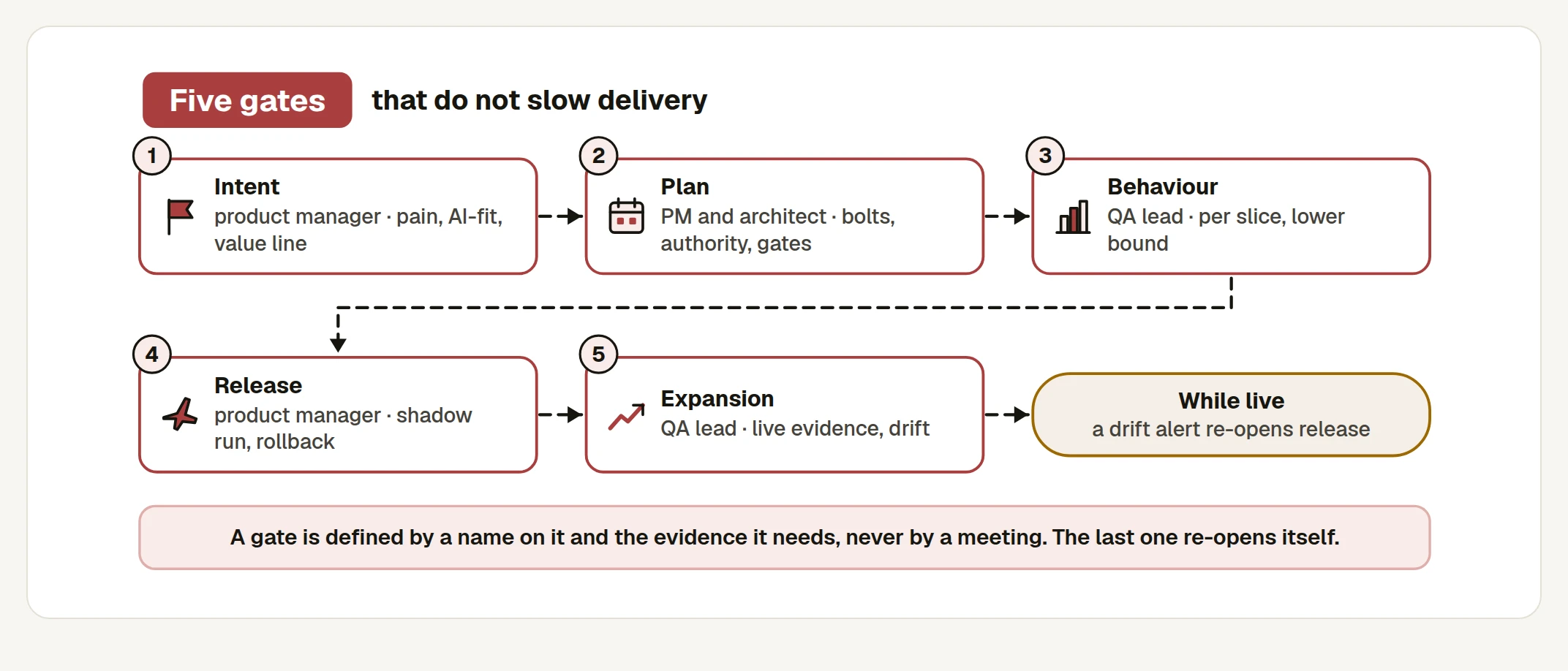
> **In short.** An AI agent passes five gates on its way to wide use, each owned by one named person deciding on
> written evidence. They are **intent** (worth doing?), **plan** (the right slice at the right control
> level?), **behaviour** (does it meet the spec?), **release** (safe to show a few real users?) and
> **expansion** (have we earned wider use?). A drift alert re-opens the release gate automatically.
**In this lesson** you'll learn:
- the five gates, who owns each, and the evidence each one needs;
- what a gate decision record contains, so a gate is a decision rather than a formality;
- how to keep governance fast: owners who can evaluate, and approvals struck that cannot.
## Sound familiar?
- A product manager is approving pull requests they cannot evaluate, and nobody signs the shadow results.
- "Governance" is a steering committee that meets monthly and asks for numbers nobody has.
- The agent launched, and nothing was set up to notice when it stopped being good enough.
Governance done this way is slow and weak at once. Done right, it is five decisions with evidence,
and each takes less time than the meeting it replaces.
## What are the five gates?
| Gate | The question | Owner | The evidence |
| --- | --- | --- | --- |
| **1 · Intent** | Is this worth doing at all? | Product manager | Pain register, AI-fit verdict, value line |
| **2 · Plan** | Is this the right slice at the right control level? | Product manager **and** architect | Bolt cut, authority budget, gate map |
| **3 · Behaviour** | Does it meet the spec? | QA lead | Golden-set score per slice, with its lower bound |
| **4 · Release** | Is it safe to show a few real users? | Product manager | Shadow-run comparison, rollback rehearsed |
| **5 · Expansion** | Have we earned wider use? | QA lead | Live evidence by slice, drift inside threshold |
## Run the gates, step by step
### Step 1 · Give each gate one owner who can evaluate it
The most common governance failure is a **product manager approving a pull request**. Strike every
approval that its owner cannot evaluate, and insist on being asked the ones they can. Behaviour and
expansion belong to QA, because they are questions about measured evidence.
### Step 2 · Write the gate decision record
Each gate decision fits on a page: the question the gate asks; the evidence that was actually in front
of the owner, **with denominators**; what would have made the answer no; any conditions; what the owner
could not evaluate and who should have; and a signature. A record like this takes minutes, and it is
what makes a gate defensible to an auditor six months later.
### Step 3 · Hold only what must halt
Most decisions in an agentic build do not need to stop anything. Only the [hard gate](https://akash-coded.github.io/aws-bedrock-agentcore-strands/learn/the-hard-gate/)
between design and build halts, along with the decisions that fail any of its four questions; the rest
run behind placeholders with an owner and a date. Treating everything as a hard gate is how
governance becomes the bottleneck.
### Step 4 · Wire the drift alert to the release gate
A released agent can stop being good enough with no deploy at all. When the output mix breaches its
drift threshold, the release gate **re-opens automatically**: nobody has to decide to reconsider.
[Drift monitoring](https://akash-coded.github.io/aws-bedrock-agentcore-strands/learn/ai-drift-monitoring/)
### Step 5 · Report two numbers, paired, every cycle
The sponsor's governance is one line: what the feature **saved** and what it **cost**, with the review
hours and re-runs beside them so neither number can be gamed. Every measure is reported next to its
side effect, because a number reported alone gets pushed.
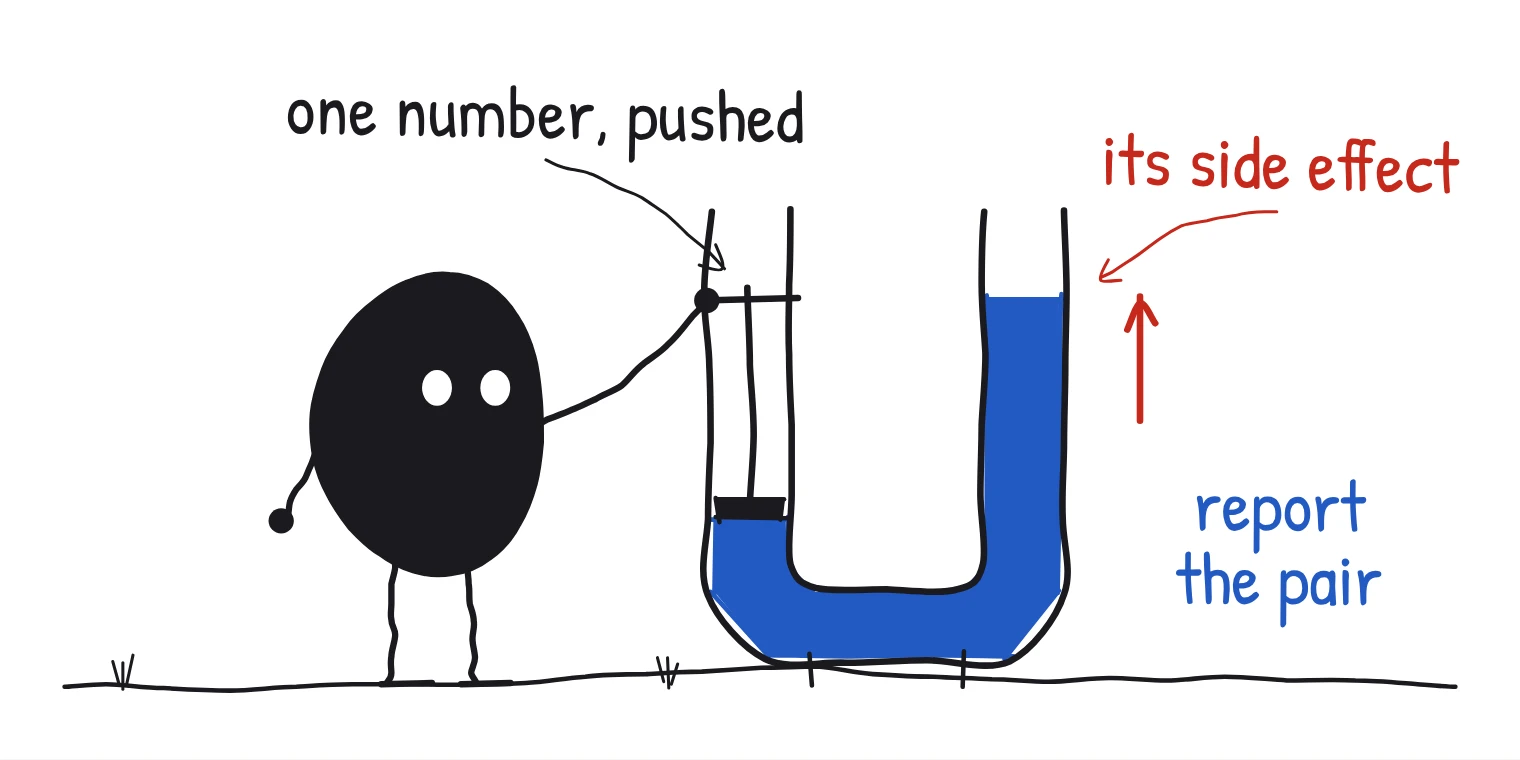
*A number reported alone gets pushed. Report what the feature saved and what it cost, with the review hours and re-runs beside them.*
## Who signs what
| Artefact | Accountable |
| --- | --- |
| Pain register, AI-fit verdict, eight-field spec, acceptance bars | Product manager |
| Quality targets, authority budget, decision records, bolt cut | Solution architect |
| Golden set and checkers | QA lead |
| Shadow comparison and cut-over | Product manager |
| Trace, redaction and the drift alert | Solution architect |
| The two-number report | Sponsor |
## Where you'll use it
- **In a governance forum**: replace status reporting with five gate records.
- **In a regulated industry**: the gate records and the evidence pack are what an auditor reads.
- **With a risk framework**: NIST's AI Risk Management Framework organises the same concerns into
govern, map, measure and manage; the five gates are where they become named decisions.
## Why it matters
Gartner lists inadequate risk controls among the three reasons it expects over 40% of agentic AI
projects to be cancelled by 2027. Controls fail less often from a lack of rules than from a lack of
owners and evidence. Five gates, each with a named owner deciding on written evidence, supply both,
without adding a single meeting.
## Try it
A company's AI approval process is a monthly committee that reviews a slide deck per project and votes.
**Which of the five gates' properties does it lack?**
Show the answer
**Almost all of them.** A vote has no single accountable owner; a slide deck is not evidence with
denominators; a monthly meeting cannot re-open a release when drift appears on a Tuesday; and a single
approval cannot distinguish intent from behaviour from expansion, which are different questions with
different evidence and different owners. The committee can stay as the place the two-number report is
read; the decisions move to named owners.