# Postmortems for AI Incidents: Find the Missing Control
Five layers of defence were claimed. None was enforced. The hour that followed produced a typed cap, a confirmation token, a lower autonomy level and six new test cases.
6 min read · Intermediate · Lesson 13 of 13 in Running delivery · Updated 2026-10-03 · By Akash Das
Canonical: https://akash-coded.github.io/aws-bedrock-agentcore-strands/learn/ai-incident-postmortem/
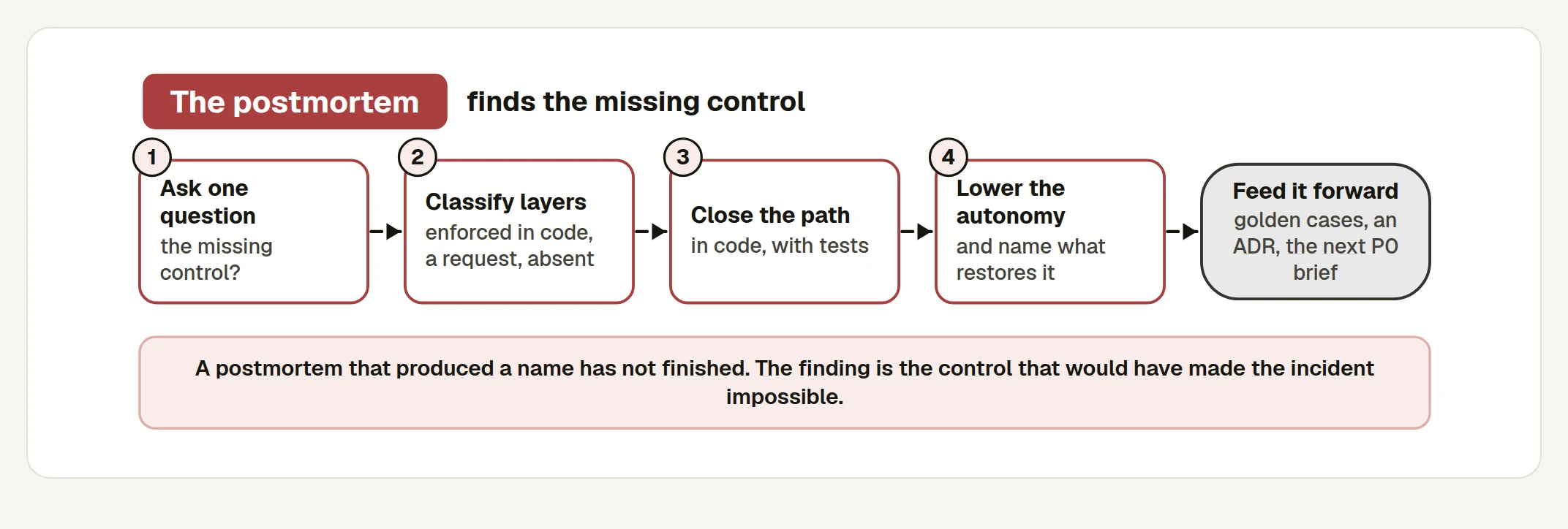
> **In short.** A postmortem for an AI incident starts from one question: **which
> enforced control, if it had been present, would have made this impossible?** It classifies every
> claimed layer of defence as enforced, a request or absent, and fixes the one that closes the path in
> code with a test. It lowers the action's autonomy until evidence restores it, and leaves as a brief
> for the next P0.
**In this lesson** you'll learn:
- the one question that turns a postmortem from a search for a person into a search for a control;
- how to classify every layer of defence honestly, with evidence;
- the four artefacts that must leave the room for the incident loop to close.
## Sound familiar?
- The action list says "remind staff of the refund policy" and "update the prompt".
- The postmortem ended with a name, and the same incident recurred a month later with a different one.
- Every layer of defence in the design document was "in place", and the incident happened anyway.
A postmortem that ends in a name, a reminder or a prompt edit has changed nothing that a model, or a
person under pressure, cannot get past again.
## Why ask for the missing control?
Because people and models both fail, and a system that depends on neither failing will fail. The
question *who was careless?* produces a name; the question *which enforced control would have made this
impossible?* produces a system change. That is the principle of blameless postmortems, and for agentic
systems it has a sharper edge: most controls that "failed" were never enforced at all. They were
sentences in a prompt.
## Run the postmortem, step by step
### Step 1 · Ask the one question, first
Write it on the wall before anything else: *which enforced control, if it had been present, would have
made this impossible?* Keep bringing the room back to it. The hour has worked if it produces a system,
not a name.
### Step 2 · Classify every layer
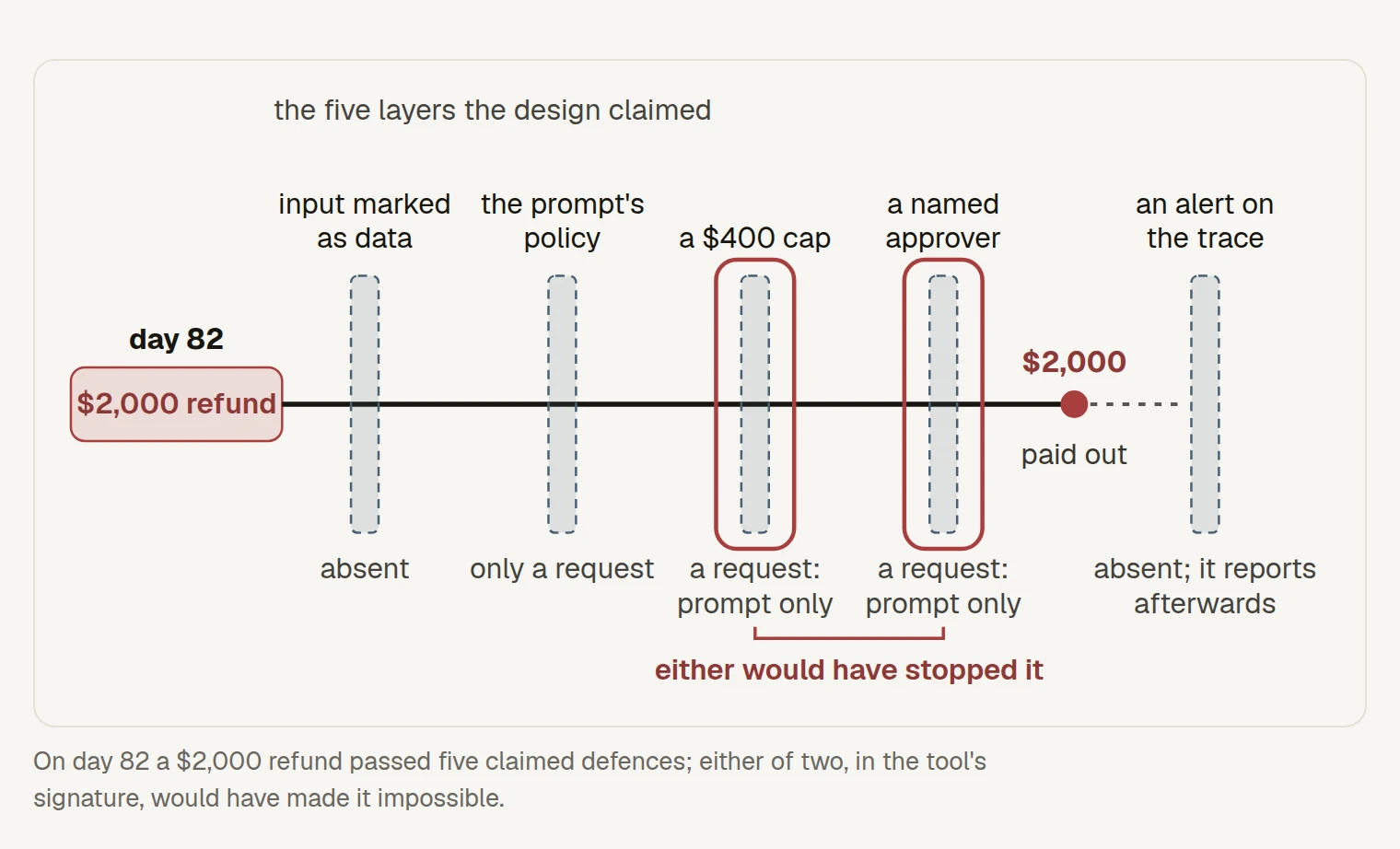
List every layer of defence the design claimed and mark each one, with evidence:
| Layer | Claimed | Reality | Would it have stopped the money? |
| --- | --- | --- | --- |
| Input marked as data | yes | **absent** | No |
| The prompt's policy | yes | **a request** | No |
| A $400 cap | yes | **a request**: in the prompt only | **Yes** |
| A named approver | yes | **a request**: in the prompt only | **Yes** |
| An alert on the trace | yes | **absent** | No, it reports afterwards |
That was SkyWays on day 82, when a **$2,000** refund went out that was not owed: five layers claimed,
none enforced, the cap and the approver written only in the prompt. The last column is the one that
matters: with either of the two enforced in the tool's signature, the refund is impossible; injection
defence and traces change the odds and the visibility, not the outcome. Every "enforced" must have a
file, a line that raises, and a test beside it.
### Step 3 · Choose the fix that closes the path
Pick the control that makes the incident impossible rather than less likely (a cap as a typed
parameter that raises, a confirmation token only a person's approval can create) and write the test
that reproduces the incident. The test of the fix: the incident is now a test that was red an hour ago.
### Step 4 · Lower the autonomy level, and say what restores it
Drop the action one autonomy level (refunds from acting alone to needing an approver) and write the
evidence that would restore it. At SkyWays refunds stayed one level down until a fourteen-day shadow
run re-earned the level.
### Step 5 · Feed it forward
Four artefacts must leave the room: **new golden cases** built from the incident (SkyWays added six),
an **amended decision record**, the **postmortem record** itself, and a **brief for the next P0** with
a pain, the evidence, the missing control, the fix and its value. Without the brief, the incident loop
has not closed. [The eight loops](https://akash-coded.github.io/aws-bedrock-agentcore-strands/learn/the-eight-loops/#step-4--close-the-incident-loop-into-framing)
## Where you'll use it
- **After every incident**, including near-misses caught by a person.
- **After every drift alert** that reveals a behaviour the design did not intend.
- **In a quarterly review**, re-reading the layer tables to check that each "enforced" is still enforced.
## Why it matters
A postmortem that ends in a name leaves every other path open, and the incident recurs with a different
name. One that ends in an enforced control closes the path for everyone, permanently, and the brief
means the next framing starts from what the incident taught.
## Try it
A draft postmortem action list reads: (1) retrain the operations team; (2) add "double-check refunds"
to the system prompt; (3) add a test that `issue_refund` raises above $400; (4) review refund logs
weekly. **Which action closes the path?**
Show the answer
**Only (3)**, and only once the cap is actually in the refund tool's signature, so the test passes
because the tool refuses. (1) and (2) are requests: training and a prompt line both lower a
probability. (4) finds the next breach after the money has left. Add a confirmation token for refunds
above the cap, lower the refund autonomy level until a shadow run re-earns it, and turn the incident
into golden cases and a P0 brief.