# How Accurate Does an AI Agent Need to Be? The 3-Step Answer
Every bar in the document is 80%, and nobody knows why. Here is where the real number comes from, and why a human hold can lower it.
7 min read · Intermediate · Lesson 6 of 13 in Running delivery · Updated 2026-10-03 · By Akash Das
Canonical: https://akash-coded.github.io/aws-bedrock-agentcore-strands/learn/how-accurate-must-an-ai-agent-be/
> **In short.** An AI agent must be accurate enough that its right answers pay for its wrong ones. So for each slice
> of work, divide the **damage** of a wrong answer by the **saving** of a right one to get *N*; the
> break-even bar is **N ÷ (N + 1)**. That is 50% where a mistake costs what a success saves, 80% where
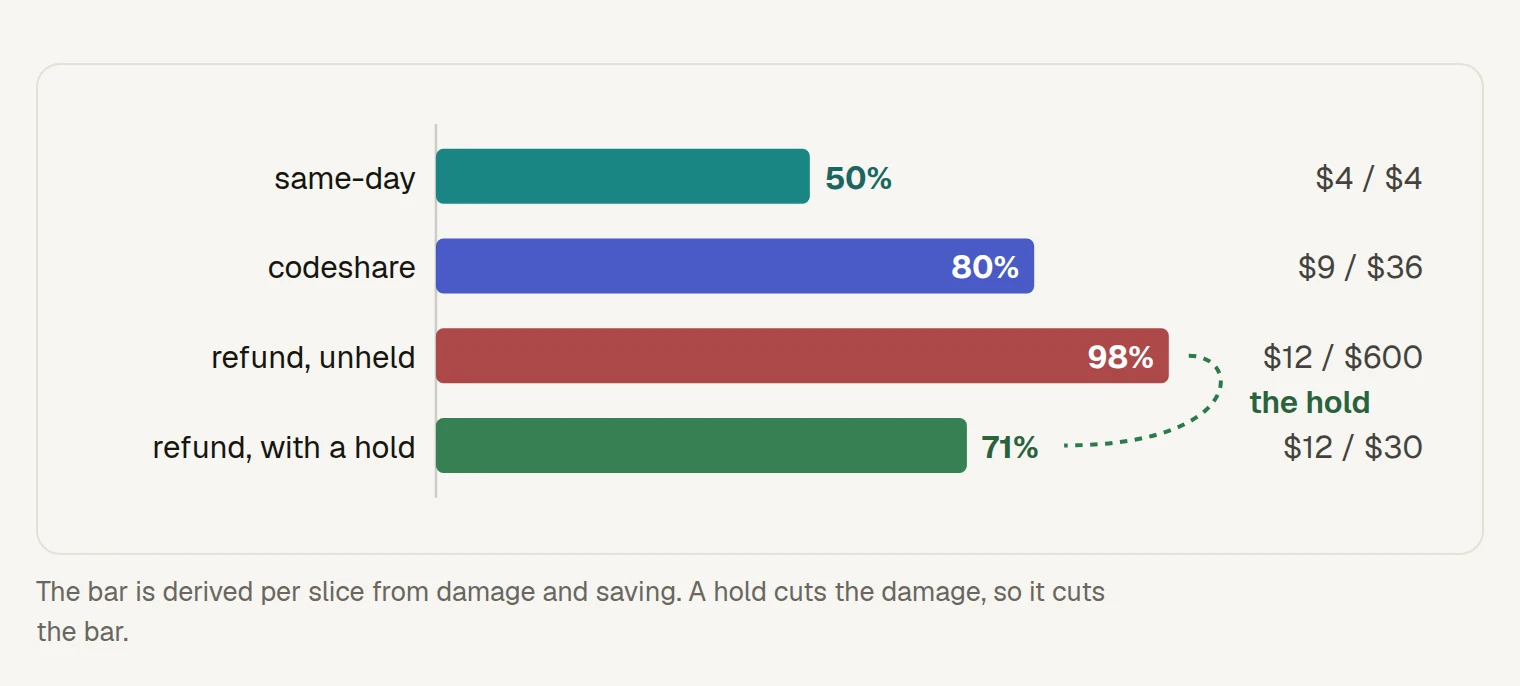
> it costs four times as much, 98% at fifty times, and lower if a person holds the action and cuts the
> damage.
**In this lesson** you'll learn:
- where the accuracy an agent needs actually comes from, and the one-line formula;
- why every slice needs its own bar, and how to cut a feature into slices;
- how a human hold lowers the bar, and when a bar is telling you to redesign.
## Sound familiar?
- Every acceptance bar in the spec is 80%, because 80% sounds rigorous.
- One accuracy number for the whole feature, and the refunds hide inside it.
- The model is at 91%, the target is 98%, and the team has spent a month trying to close the gap with prompts.
Each is a bar that was chosen instead of derived. Derived bars are different for every slice, and one
of them usually says the design needs changing, not the model.
## Where does the bar come from?
From what a right answer saves and what a wrong one costs. If a right answer saves *s* and a wrong one
costs *d*, then at accuracy *a* the agent earns *a × s* and loses *(1 − a) × d* per case. It breaks
even when those are equal, which gives:
> **N = damage ÷ saving**, and **bar = N ÷ (N + 1)**
One wrong case undoes the saving from *N* right ones, so the agent breaks even at *N* right for every
wrong. Anything above the bar is value; anything below it costs more than it saves.
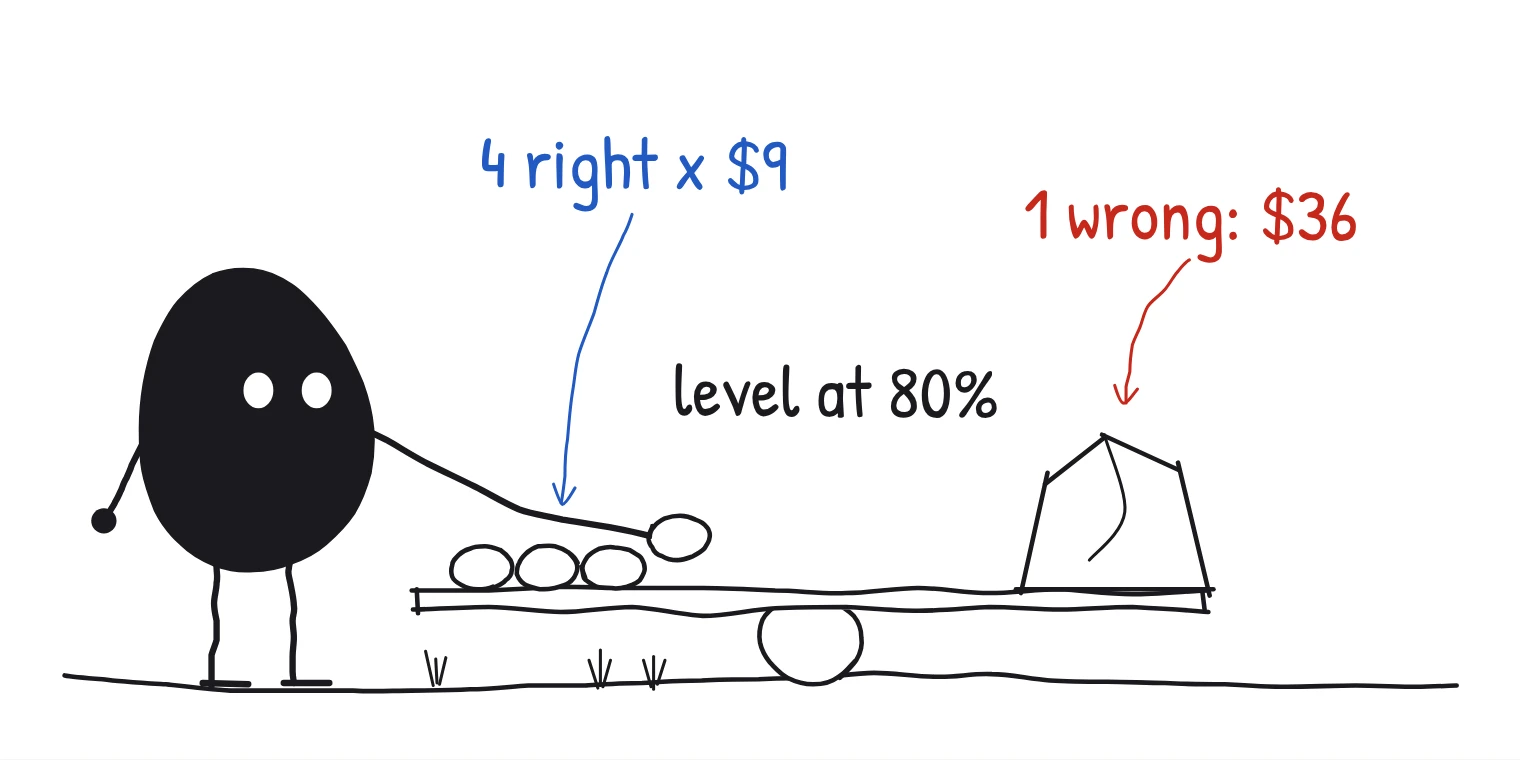
*The bar for partner flights is 80% because one wrong answer weighs as much as four right ones.*
## Set the bar, step by step
### Step 1 · Cut the feature into slices that fail differently
A slice is a group of cases whose mistakes cost about the same. SkyWays, the fictional airline this
manual follows, cut its rebooking assistant into same-day moves, codeshare rebookings and refunds,
because a wrong same-day suggestion costs a few dollars of an agent's time and a wrong refund costs
the refund.
### Step 2 · Put a saving and a damage on each slice
| Slice | Saving | Damage | N | Bar |
| --- | --- | --- | --- | --- |
| Same-day lookup | $4 | $4 | 1 | **50%** |
| Codeshare rebooking | $9 | $36 | 4 | **80%** |
| Refund, no hold | $12 | $600 | 50 | **98%** |
| Refund, **with a human hold** | $12 | $30 | 2.5 | **71%** |
Damage is not always money: a wrongly refused benefit, a misleading medical summary. Put a number on
it anyway; if you genuinely cannot, that is the finding: the step needs a person regardless of any bar.
### Step 3 · Read the bars for design, not just for testing
The last two rows are the lever. **A hold lowers the damage, so it lowers the bar**: a person checking
refunds before they go out cuts the damage of a wrong one from $600 to $30, and the bar from 98% to
71%. Nothing about the model changed. That is why a human in the loop is a commercial instrument, not
friction, and why a bar above about 95% is usually a design smell: it says the step is too dangerous
to run unheld, and the answer is a hold, not a better prompt.

## Where you'll use it
- **In P1**, before any prompt is written: the bars go into the eight-field spec and are signed at
the hard gate.
- **When the team is arguing about "accuracy"**: ask which slice, and what a mistake costs in it.
- **When an agent is stuck below a very high bar**: redesign with a hold, and re-derive the bar.
## Why it matters
A bar that is not derived cannot be defended when a regulator, a customer or a finance director asks
why the agent was allowed to launch. A derived bar is a sentence: *it breaks even at 80% on codeshare,
because a wrong one costs four times what a right one saves.* And one bar per feature ships the hard
slice below its bar while the easy one is held back for no reason.
## Try it
A support agent drafts replies that a person always reads before sending (saving $2 a case, damage $1
when a person must rewrite it). It also issues goodwill credits alone (saving $3, damage $45 when one
is issued wrongly). **What bar does each need, and what would you change?**
Show the answer
**Drafts: 33%. Credits: about 94%.** For drafts N = 1 ÷ 2 = 0.5 and the bar is 0.5 ÷ 1.5 ≈ 33%: the
person reading each draft keeps the damage small. For credits N = 45 ÷ 3 = 15 and the bar is
15 ÷ 16 ≈ 94%, which is close to the design-smell line. The change: put a hold on credits (a person
approves any credit above a threshold) and re-derive; if the hold cuts the damage to $6, N = 2 and
the bar falls to about 67%.
```
## Sources and credits
| Idea | Origin | Source |
| --- | --- | --- |
| The break-even bar N ÷ (N + 1), per slice, and the hold as a lever | **Original**: this manual | [Formulas](https://github.com/akash-coded/aws-bedrock-agentcore-strands/wiki/Formulas-and-Calculators#the-acceptance-bar--working-method) · [Mental Models](https://github.com/akash-coded/aws-bedrock-agentcore-strands/wiki/Mental-Models#a-hold-is-a-lever-not-a-brake) |
| Expected-value break-even for a decision under uncertainty | **Borrowed** | Standard decision theory; see Raiffa, H. (1968). *Decision Analysis*. Addison-Wesley |
| The SkyWays slices and figures | **Illustrative**: a fictional airline | [Try the bar calculator](https://akash-coded.github.io/aws-bedrock-agentcore-strands/workbench/#/toolkit/bar) |