# How to Run an Agentic AI Project: A Step-by-Step Playbook
The whole lifecycle on one page, in the order you will do it. Each step links to the lesson that goes deeper.
7 min read · Beginner · Lesson 1 of 13 in Running delivery · Updated 2026-10-03 · By Akash Das
Canonical: https://akash-coded.github.io/aws-bedrock-agentcore-strands/learn/how-to-run-an-agentic-ai-project/
> **In short.** Run an agentic AI project in twelve steps across four phases: in **P0**, measure the pain, decide
> whether it needs a model, and set autonomy per action. In **P1**, map every step, write an
> eight-field spec with a bar per slice, and put every limit in code; in **P2**, build in bolts behind
> a harness and prove it in shadow. In **P3**, widen on evidence, watch for drift and report what it
> saved beside what it cost.
**In this lesson** you'll learn:
- the twelve steps of an agentic AI project, in order, with the owner of each;
- what each step leaves behind, so you know when it is done;
- where the model helps at each step, and the one decision per phase it must never make.
## Sound familiar?
- The project plan is a Gantt chart with "build the agent" as one bar in the middle.
- Nobody can say who decides whether the agent is good enough to launch.
- The steps exist, but in the wrong order: the prototype came first and the requirements were written around it.
The order is the point. Every step below makes a later one cheaper, and doing them out of order is
how agentic projects end up rebuilt.
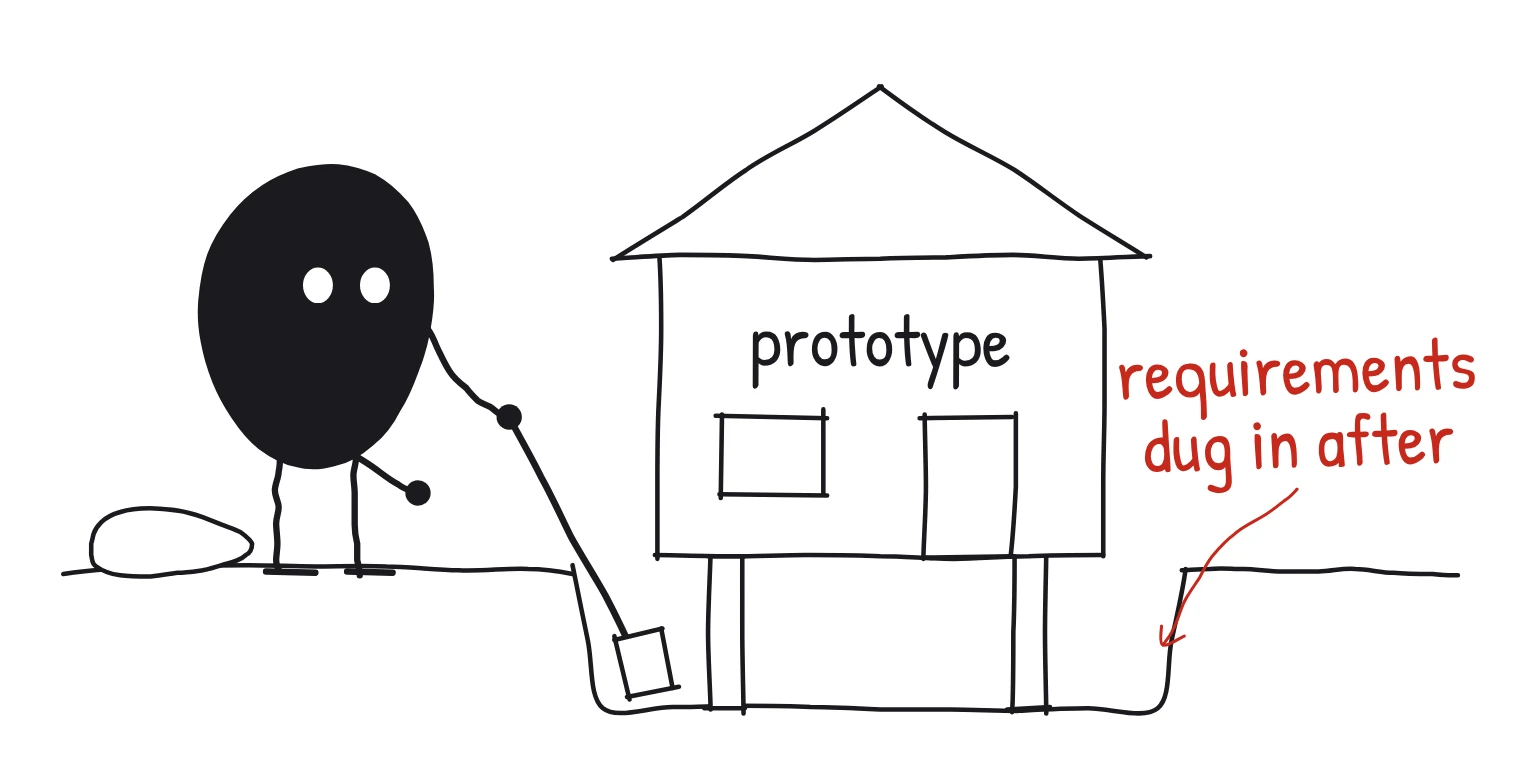
*Build the prototype first and the requirements get written around it. The order of the twelve steps is the point.*
## The twelve steps
### P0 · Frame: is it worth doing, and is it AI at all?
**Step 1 · Measure the pain.** Turn the request into one line: who has the problem, how often, what
it costs today, and the evidence. *Owner: product manager.* [P0 Frame](https://akash-coded.github.io/aws-bedrock-agentcore-strands/learn/p0-frame/)
**Step 2 · Decide whether it is AI at all.** A genuine judgement call? Enough volume? Recoverable if
wrong? Two or three of your top five requests will come back as rules. *Owner: product manager.*
**Step 3 · Size the value and set autonomy per action.** Net value after running and checking it, and
an autonomy level for each action from what a mistake costs. *Owner: product manager, with the sponsor.*
### P1 · Design & Spec: what exactly, and under whose authority?
**Step 4 · Map every step.** Tag each step exact, best-guess or consequential; exact work goes in
code. *Owner: solution architect.* [P1 Design & Spec](https://akash-coded.github.io/aws-bedrock-agentcore-strands/learn/p1-design-and-spec/)
**Step 5 · Write the eight-field spec and derive the bars.** One screen, acceptance in EARS, a bar
per slice from damage and saving. *Owner: product manager, with QA.*
[How accurate an agent must be](https://akash-coded.github.io/aws-bedrock-agentcore-strands/learn/how-accurate-must-an-ai-agent-be/)
**Step 6 · Set the authority budget, and sign the hard gate.** Every tool banded, every cap in a
signature with a test. Nothing enters P2 until the spec, the bars and the budget are signed.
*Owner: solution architect.* [The hard gate](https://akash-coded.github.io/aws-bedrock-agentcore-strands/learn/the-hard-gate/)
### P2 · Build & Prove: does it meet the bar, slice by slice?
**Step 7 · Cut bolts, walking skeleton first.** One unknown per bolt, cut by dependency, integrated
the same day. *Owner: engineering lead.* [Bolts vs sprints](https://akash-coded.github.io/aws-bedrock-agentcore-strands/learn/bolts-vs-sprints/)
**Step 8 · Build the exact floor and the gated tools.** Functions and tests before prompts; caps that
raise; confirmation tokens the model cannot mint. *Owner: engineering lead.*
[Guardrails that hold](https://akash-coded.github.io/aws-bedrock-agentcore-strands/learn/ai-guardrails-that-hold/)
**Step 9 · Put the harness in CI.** Golden cases per slice, the lower bound reported, a merge blocked
when a touched slice falls below its bar. *Owner: QA lead.* [Prove the bar](https://akash-coded.github.io/aws-bedrock-agentcore-strands/learn/prove-ai-accuracy/)
**Step 10 · Run it in shadow.** The agent decides on live traffic and acts on nothing; agreement per
slice over a window fixed in advance. *Owner: QA lead.* [Shadow and cut-over](https://akash-coded.github.io/aws-bedrock-agentcore-strands/learn/shadow-mode-and-cutover/)
### P3 · Run & Learn: is it still true, and what did it cost?
**Step 11 · Cut over at 5%, widen on evidence, rehearse the rollback.** Each widening names the
evidence that earned it. *Owner: product manager and DevOps.* [P3 Run & Learn](https://akash-coded.github.io/aws-bedrock-agentcore-strands/learn/p3-run-and-learn/)
**Step 12 · Watch, report, and feed the next P0.** Drift against two thresholds; the saving beside
the spend; every incident turned into a control and a brief. *Owner: sponsor.*
[Drift](https://akash-coded.github.io/aws-bedrock-agentcore-strands/learn/ai-drift-monitoring/) · [Postmortems](https://akash-coded.github.io/aws-bedrock-agentcore-strands/learn/ai-incident-postmortem/)
## Where the model helps, and where it must not
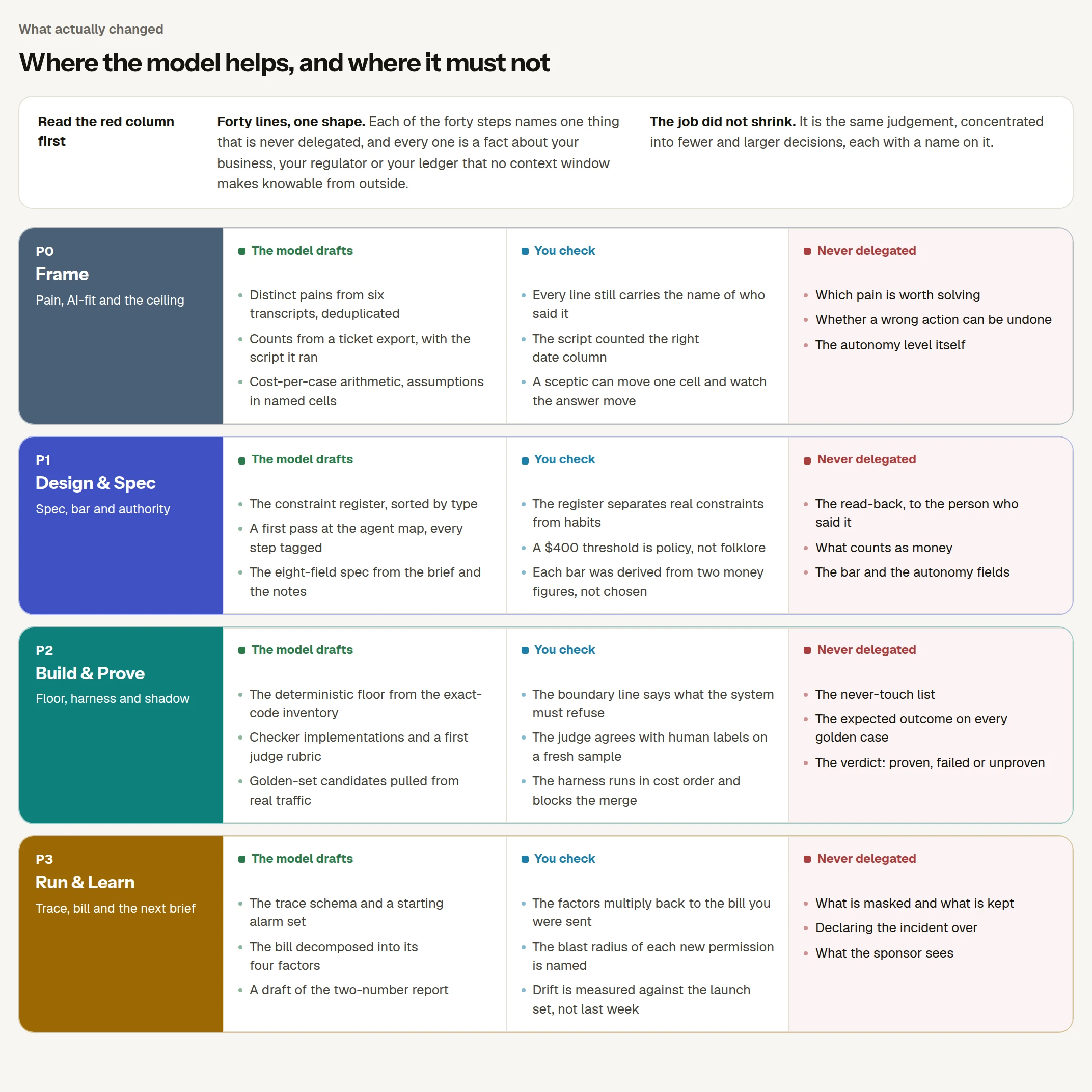
The board above draws it phase by phase: **the model drafts, you check, and one thing per step is
never delegated**. The model can draft the pain register from interview notes, the spec from the
PRD, the tests from the spec and the postmortem from the trace. It must not decide what a mistake
costs your business, which actions it may take alone, whether a slice is good enough, or who is
accountable: those are facts about your business, regulator and ledger that no context makes
knowable from outside.
## Where you'll use it
- **As the project plan's skeleton**: twelve steps, each with an owner and an artefact, instead of one
"build the agent" bar.
- **In a kick-off**, to show every role where it is accountable, and where it deliberately is not.
- **As an audit checklist** for a project already under way: find the first step that was skipped.
## Why it matters
Most agentic projects have the right activities in the wrong order. The prototype arrives before the
pain is measured, so the value is unknown; the build starts before the bar is set, so "good enough"
is argued at launch; the cap is decided in a document and enforced nowhere. The order in this list is
what prevents each of those.
## Try it
A team has a working prototype of a refund agent, a slide deck, and a launch date six weeks away.
**Which of the twelve steps is most likely to have been skipped, and what does it cost to do now?**
Show the answer
**Most likely steps 1, 5 and 6** (the measured pain, the bar per slice and the authority budget)
because a prototype-first project jumps from an idea to step 8. Doing them now is still cheap: a pain
line and a value line are an afternoon; the bars are arithmetic once the damage and saving per slice
are known; and the authority budget is a table plus a typed cap and two tests in the refund tool. What
is expensive is skipping them and discovering the gaps after launch.