# How to Roll Out Agentic AI Delivery: A 90-Day Plan
The sequence that works is deliberately unglamorous in the middle, and each phase has one trap that reliably catches capable teams.
8 min read · Intermediate · Lesson 4 of 4 in Teams and organisation · Updated 2026-10-02 · By Akash Das
Canonical: https://akash-coded.github.io/aws-bedrock-agentcore-strands/learn/rolling-out-agentic-delivery/
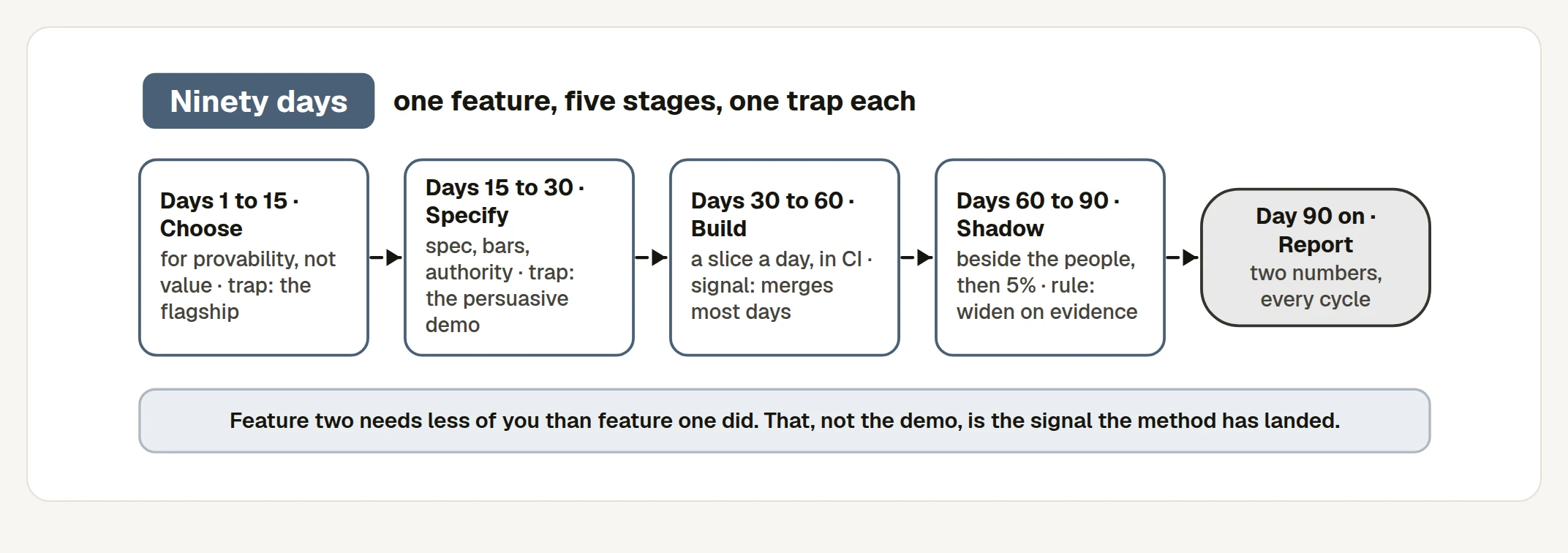
> **In short.** Roll out agentic delivery one feature at a time over ninety days. Pick a feature for provability
> rather than value and take a baseline (days 1 to 15), then write the spec, the bars, the authority
> budget and a context file (15 to 30). Build in daily slices proven in CI (30 to 60), run it in
> shadow beside the people doing the work, cut over at 5% (60 to 90) and report two numbers from the
> first cycle.
**In this lesson** you'll learn:
- the five phases of a first rollout, and the trap or signal in each;
- why the first feature is chosen for provability, with the arithmetic that proves it;
- the six objections you will hear, and what answers each.
## Sound familiar?
- The first agentic project was the flagship, and a year later it is still a pilot.
- A demo convinced everyone in week three, and nothing has reached production since.
- The people doing the work today are described as resistant, and nobody has asked them anything.
Each is a sequencing mistake, and none needs a reorganisation to fix.
## What does a first rollout have to achieve?
**One feature proven end to end, whose artefacts the second feature can copy.** Not a portfolio of
pilots, and not tool adoption. The first feature buys the organisation a spec template, a bar derivation,
an authority budget, a harness in CI and a rehearsed rollback, and the evidence that the method works
here. The second feature should then need less attention than the first.
## Roll it out, step by step
### Step 1 · Days 1 to 15: pick the wrong-looking thing
Choose one feature for **provability rather than value**: high volume, low damage per mistake, and an
existing human process to compare against. Run the three AI-fit questions across the top ten candidates
and publish the ones that came back as rules. **Take the baseline now**: person-days per story, before
anything changes. **The trap:** starting with the flagship, which has the highest bar, the least
tolerance for a first attempt and the most spectators. [Is it AI work?](https://akash-coded.github.io/aws-bedrock-agentcore-strands/learn/p0-frame/)
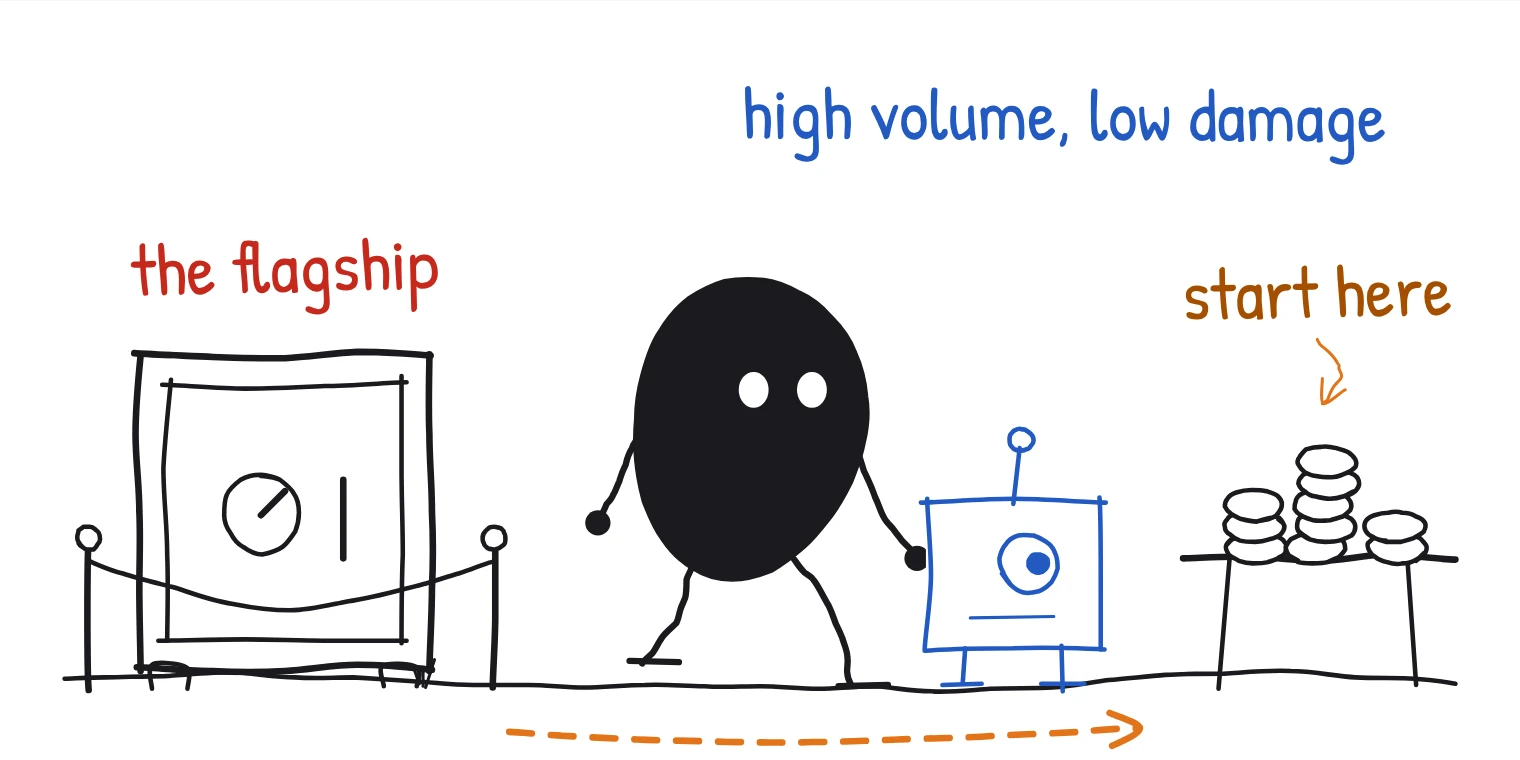
*Pick the first feature for provability, not value. The flagship has the highest bar, the least tolerance for a first attempt and the most spectators.*
### Step 2 · Days 15 to 30: write the artefacts nobody wants to write
The eight-field spec, the acceptance bar per slice, the authority budget and a context file in the
repository. Five of the eight spec fields will be undecided, and those five are the value of the
exercise. **The trap:** a demo exists by now and it is persuasive. A demo is the easy 20%; it cannot tell
you how often the system is wrong on the cases you did not choose. [P1 · Design and Spec](https://akash-coded.github.io/aws-bedrock-agentcore-strands/learn/p1-design-and-spec/)
### Step 3 · Days 30 to 60: build in slices, prove in CI
A shippable slice a day, each proven before the next: a walking skeleton with no model in it first, caps
moved out of prompts into tool signatures, the golden set at fifty real cases running in CI, review
routed by risk band. **The signal:** something merged most days. If the demo is still the only evidence
at day 45, the slices are not slices. [P2 · Build and Prove](https://akash-coded.github.io/aws-bedrock-agentcore-strands/learn/p2-build-and-prove/)
### Step 4 · Days 60 to 90: prove it beside the humans
Run it in shadow next to the people doing the work, deciding but never acting, for a window agreed in
advance and read daily per slice. Keep money actions gated whatever the shadow shows. Rehearse the
rollback before the cut-over, then cut over at 5% and widen on live evidence rather than on a date. If it
does not match, you learned that for free. [Shadow and cut-over](https://akash-coded.github.io/aws-bedrock-agentcore-strands/learn/shadow-mode-and-cutover/)
### Step 5 · Day 90 onward: report honestly, and let production set the agenda
Two numbers from the first cycle: the saving and the spend. A surprise bill goes back into the design,
an incident produces a control rather than a name, drift is watched weekly, and the maturity check is
re-run each quarter. **The signal that it took:** the second feature needs less of your attention than
the first, because the artefacts now exist to copy. [The maturity model](https://akash-coded.github.io/aws-bedrock-agentcore-strands/learn/ai-delivery-maturity-model/)
### Step 6 · Meet the resistance with evidence, not persuasion
| What you will hear | What is underneath | What answers it |
| --- | --- | --- |
| "This slows us down" | True for the first feature, untrue by the third | Show the artefacts being reused: the second spec takes an hour |
| "The model is good enough already" | Judged on curated examples | Ask for the score on the slice nobody picked, with its sample size |
| "We already have gates" | Approvals, not gates: clicks without evidence | Ask what would have made the last approver say no |
| "Engineering says the cap is handled" | Handled in a prompt | Ask to be shown it: prose or code decides the answer |
| "We cannot take a baseline, we have started" | True, and recoverable on the next feature | Say so in the report, and take one next time |
| "Our people will resist automation" | Often they resist being measured by it | Put the frontline in discovery first, and credit their requirements by name |
The move that does most of the change management is unglamorous: **credit every requirement to the
person who raised it, in writing, before consolidating any of them.** A voice that felt dropped in week
one comes back in week five as a constraint.
## When to use it
- **For an organisation's first agentic feature**, or its first since a failed pilot.
- **When a portfolio of pilots has stalled**: pick one, and run it through all five phases.
- **When a new business unit adopts the method**, with the first unit's artefacts as templates.
## Why it matters
A first rollout is decided in the two places teams most want to rush: the fortnight of artefacts, which
turns a demo into something that can be proven, and the shadow run, which is the only way to learn
whether the system agrees with the people doing the work. The plan spends its effort there, and the
first feature's artefacts are what make the second one cheaper.
## Try it
Leadership wants to start with the flagship: an agent that approves refunds. A wrong refund costs
nineteen times what a right one saves, and about twelve refund cases arrive a day. The alternative is an
agent that drafts replies, where a bad draft costs twice what a good one saves. **Using the bar, why
start with the drafts?** (Hypothetical numbers; assume the agent is right 96% of the time on refunds and
80% on drafts.)
Show the answer
**Because the refund slice cannot be proven inside a quarter.** Its bar is 19 ÷ 20 = 95%. Proving 95%
when the agent is right 96% of the time needs about 1.96² × 0.96 × 0.04 ÷ 0.01² ≈ 1,475 cases: at twelve
a day, about four months of evidence before the shadow run can end. The drafts' bar is 2 ÷ 3 ≈ 67%, and at
80% the Wilson lower bound clears it on about fifty cases. Start with the drafts, keep refunds with a
person, and let the first feature's artefacts carry the second.