# How to Structure Teams for Agentic AI: Roles, Pods and Seams
Your org chart is already a system design. In agentic AI it decides where the agent boundaries fall, whether you meant it to or not.
6 min read · Intermediate · Lesson 1 of 4 in Teams and organisation · Updated 2026-10-02 · By Akash Das
Canonical: https://akash-coded.github.io/aws-bedrock-agentcore-strands/learn/team-structure-for-agentic-ai/
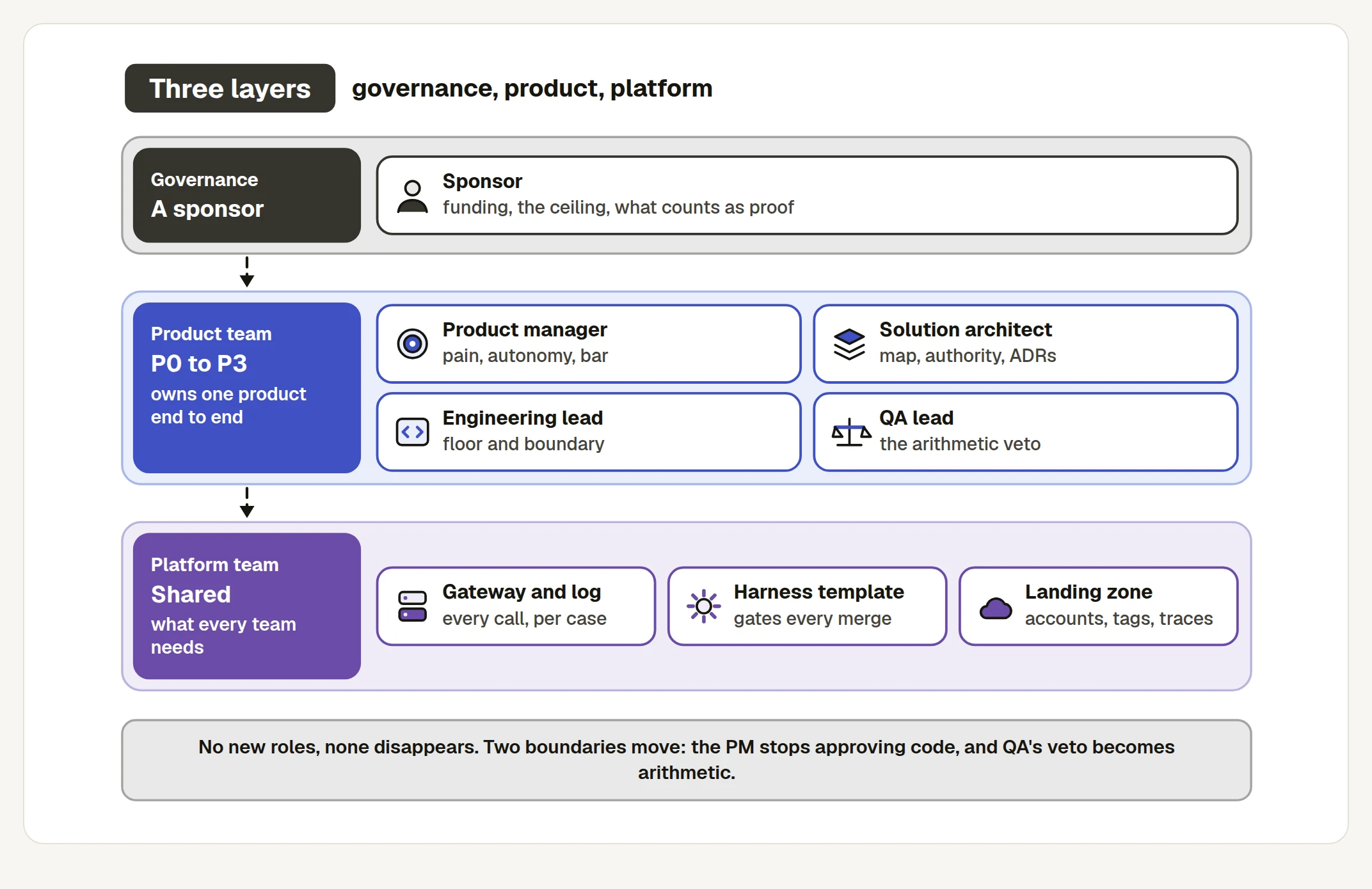
> **In short.** Agentic AI needs no new roles and removes none, but two boundaries move: the product manager stops
> approving code, and QA gains an arithmetic veto. Keep a small product team (product manager,
> architect, engineering lead, QA lead) owning one product from P0 to P3, with a platform team for
> what every team needs (the gateway, the harness, the landing zone). Put the system's seams where the
> team boundaries already are, and name one sponsor who owns governance.
**In this lesson** you'll learn:
- why agentic AI needs no new roles, and which two boundaries between roles move;
- how to split product teams, a platform team and governance;
- why the system's seams follow the org chart, and what to do about it.
## Sound familiar?
- A central "AI team" builds agents for other departments, and neither side owns the result.
- Every team built its own model integration, and nobody can say what the organisation spends.
- The multi-agent design has one agent per department, and the hand-offs between them are where it breaks.
Each is an organisational decision showing up as a technical defect.
## What changes in the organisation?
Less than the market implies. **Five roles; none is new, none disappears.** What moves is the boundary
between them, in two places: **the product manager stops approving things they cannot evaluate**, and
**QA gains a veto that is arithmetic rather than opinion**. A slice whose lower bound is below its bar
does not pass. Almost everything else is the discipline you already have, applied to a product that is
now partly probabilistic.
## Structure it, step by step
### Step 1 · Keep the five roles, and move the two boundaries
Product manager, solution architect, engineering lead, QA lead, DevOps and platform, plus a sponsor.
Write down, per role, what is theirs and what is not, and remove the approvals people cannot evaluate.
[Who signs what](https://akash-coded.github.io/aws-bedrock-agentcore-strands/learn/ai-governance-gates/#who-signs-what)
### Step 2 · Give each product one team that owns it end to end
A small product team (a pod of four, plus DevOps support) owns one product, or one agent, from framing
to operation: the pain, the spec, the build, the proof and the running system. The decisions that matter most (the bar, autonomy per
action) are business decisions, so they belong with the team that owns the business outcome, not with a
separate AI group.
### Step 3 · Build a platform team for what every product team needs
Everything that should be the same everywhere goes to one platform team: the model gateway with its
per-call log, the landing zone and cost tags, the harness template, flags and traces. The one decision to
take centrally is not which assistant (teams can choose their own editor) but that every model call in
production passes through one layer you own. The gateway is a fortnight of work, and without it a
surprise invoice is a mystery rather than a diagnosis.
### Step 4 · Put the seams where the teams are
A system's structure tends to copy the communication structure of the organisation that builds it:
Conway's law. In agentic AI that means **agent boundaries follow team boundaries**: one agent per
department is often an org chart, not a design. Decide the seams on purpose. Start with one agent per
product and give each hand-off a named limit; *n* agents have n(n − 1) ÷ 2 possible hand-offs, and so do
*n* teams.
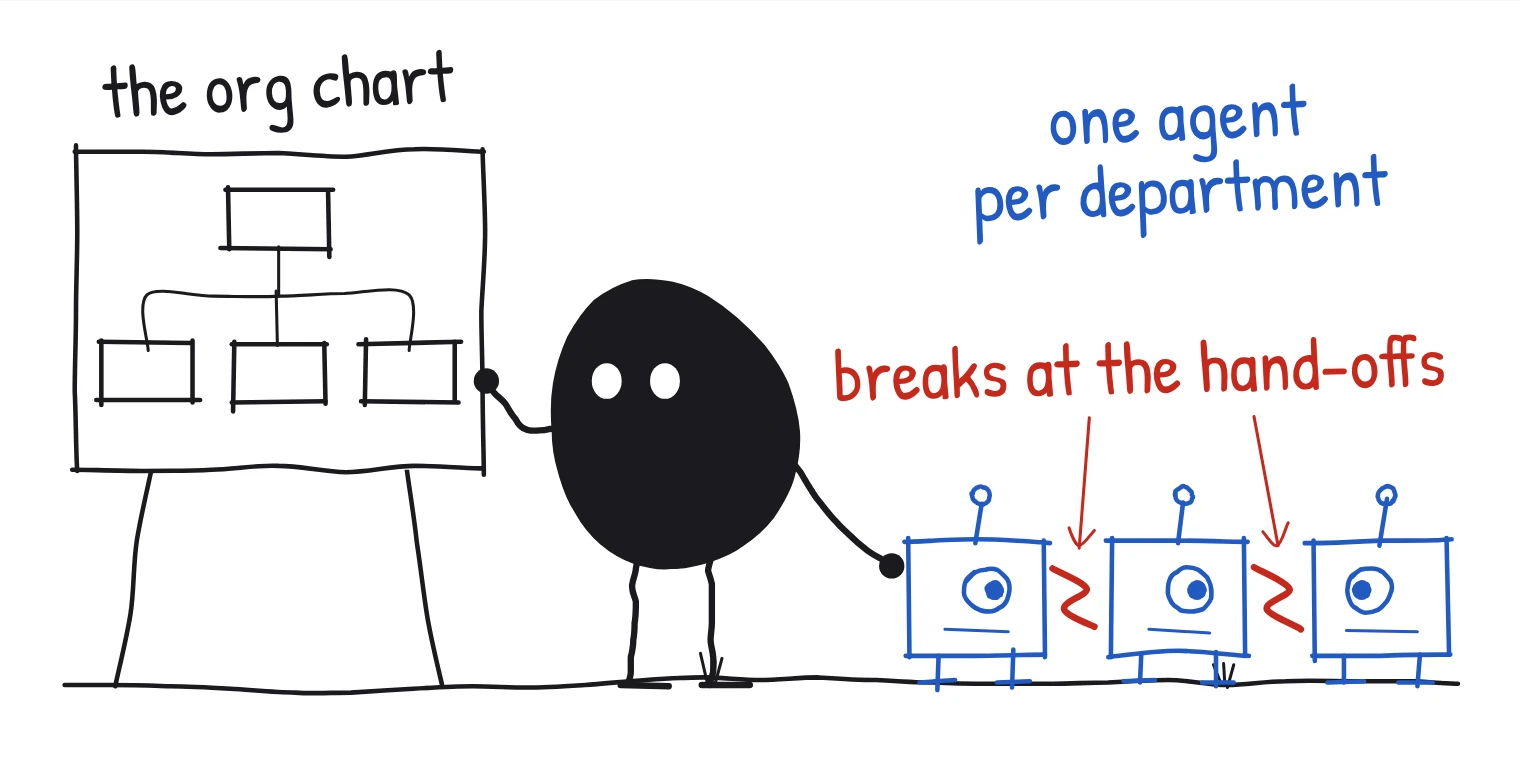
*One agent per department is often an org chart, not a design. Decide the seams on purpose, and give each hand-off a named limit.*
### Step 5 · If you have a central AI group, make it enable rather than build
A central group earns its place by coaching the method across teams and by providing the platform, not
by building other people's agents, which separates the model from the business decisions it depends
on. That is the difference between an enabling or platform team and a bottleneck.
### Step 6 · Name one governance owner
Governance spans the whole lifecycle and belongs to no delivery role. Name the sponsor who owns it. If
the answer is "we all do", nobody does.
## Where you'll use it
- **When an organisation starts its second or third agentic product** and the first one's shortcuts start to hurt.
- **When costs or model integrations have fragmented** across teams.
- **When a multi-agent design mirrors the org chart**: check whether that was a decision.
## Why it matters
Agentic AI needs no reorganisation to start, and a wrong structure makes it expensive to scale: agents
owned by nobody, integrations duplicated everywhere, hand-offs placed where departments meet rather
than where the work divides. The structure above keeps decisions with the people who own the outcome,
and the shared machinery in one place.
## Try it
A company plans an "AI Centre of Excellence" of twelve engineers who will build agents for sales,
support and finance on request. **What would you change?**
Show the answer
**Split it into a platform team and an enabling team, and move the building to the product teams.** The
platform half runs the gateway, the landing zone, the harness template and the traces for everyone. The
enabling half coaches the method (framing, bars, authority budgets) inside each product team. Sales,
support and finance each own their agent end to end, because only they can decide what a mistake costs
them and what the agent may do without a person.