# The 8 Feedback Loops of AI Delivery and the 3 Teams Forget
A phase ends; a loop comes back. The loops with nobody waiting at the far end are the ones that decide whether a project becomes a practice.
7 min read · Intermediate · Lesson 8 of 9 in Agentic PDLC fundamentals · Updated 2026-10-03 · By Akash Das
Canonical: https://akash-coded.github.io/aws-bedrock-agentcore-strands/learn/the-eight-loops/
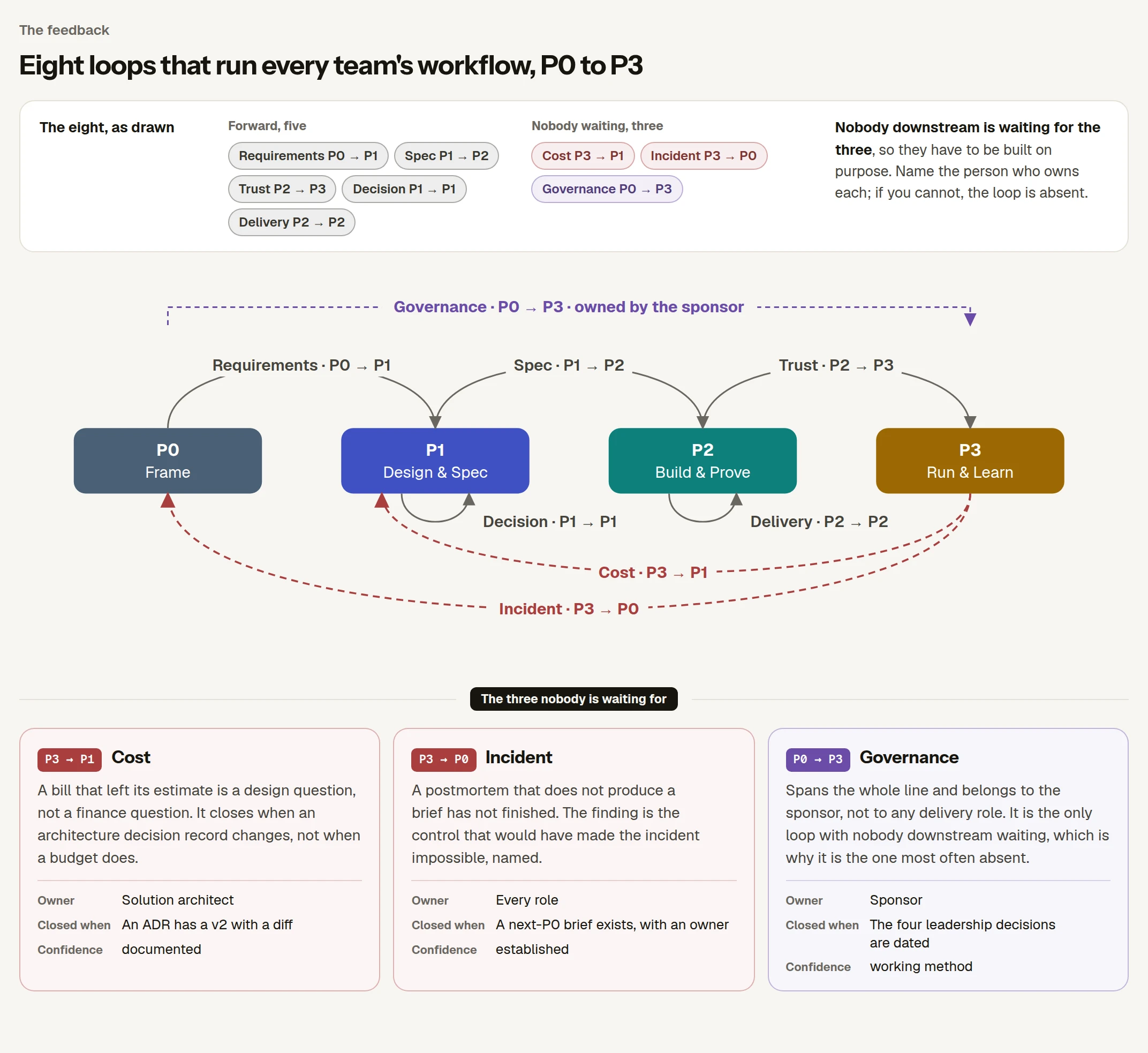
> **In short.** Each of the eight loops opens in one phase of the agentic PDLC and closes in a
> later one when evidence from the far end **changes an artefact at the near end**. Five close on
> their own because someone downstream is waiting. Three close only if a named person makes them:
> cost back into design, incidents back into framing, and governance across the whole line.
**In this lesson** you'll learn:
- what the eight loops are, where each opens and closes, and who owns it;
- the precise difference between a loop that is closed, open and absent;
- how to close the three loops that nobody is waiting on.
## Sound familiar?
- The bill doubled, a budget increase was approved, and the same thing happened next quarter.
- The postmortem produced eleven action items in a tracker, and the incident recurred with a different name.
- Numbers reach the steering committee only when the steering committee asks for them.
Each is a loop that was never closed, handled as a conversation instead of as a change to the design.
## What are the eight loops?
The four phases of the [agentic PDLC](https://akash-coded.github.io/aws-bedrock-agentcore-strands/learn/what-is-the-agentic-pdlc/) are a line. The loops are
what make the line a ring: each one carries something learned in a later phase back to the artefact
it should change.
| Loop | Opens | Closes | Owner | What it carries |
| --- | --- | --- | --- | --- |
| Requirements | P0 | P1 | Solution architect | Credited requirements, typed constraints, ratified quality targets |
| Spec | P1 | P2 | Product manager | The eight-field spec, a bar per slice, a golden set that proves it |
| Decision | P1 | P1 | Solution architect | Choices sorted into hard and soft gates, a record per trade-off |
| Delivery | P2 | P2 | Engineering lead | Bolts in dependency order, a harness that gates each merge |
| Trust | P2 | P3 | QA lead | The bar proven, the shadow run, a cut-over that starts at 5% |
| **Cost** | P3 | **P1** | Solution architect | A bill traced to its cause and back to the decision that allowed it |
| **Incident** | P3 | **P0** | Every role | The missing control, named, and the brief for the next P0 |
| **Governance** | P0 | P3 | Sponsor | One owner per artefact, and two numbers every cycle |
**Five close forwards or inside a phase**, and they look after themselves: somebody downstream is
waiting and will chase. **Three have nobody waiting.** Cost closes backwards into design, incident
closes backwards into framing, and governance spans the whole line and belongs to no delivery role.
## How to run the loops, step by step
### Step 1 · Agree what "closed" means
A loop is closed when something learned at the far end has changed an artefact at the near end, and
you can point at the change: not a discussion, not a ticket, not a lesson learned.
| Word | Means | The test |
| --- | --- | --- |
| **Closed** | An artefact where the loop opens has been changed by evidence from where it closes | Show the diff |
| **Open** | The evidence exists and has a named owner, and the artefact has not changed yet | Show the owner and the date |
| **Absent** | Nobody is accountable for the return path | You cannot name a person |
"Informal" is not one of the three. A loop that closes when somebody happens to remember is absent
with better manners.
### Step 2 · Name one person for each loop
For each of the eight, write a name: a person, not a team. The five forward loops usually already
have one. For the three loops nobody waits for, the honest first answer is often that nobody owns
them, and "absent" is the right word for that.
### Step 3 · Close the cost loop into the design
A bill that left its estimate is a **design** question, not a finance question. At SkyWays, the
fictional airline this manual follows, the day-75 bill was 4.4 times its estimate on flat traffic.
Handled as a budget question, it recurs next quarter with a different multiple. Handled as a loop,
the per-call log traced it to four habits, and the model-tier decision record got a second version:
classification moved to the cheap tier, judgement stayed on the capable one, and cost per case became
a monitored number. **It closes when a decision record has a new version with a diff.**
### Step 4 · Close the incident loop into framing
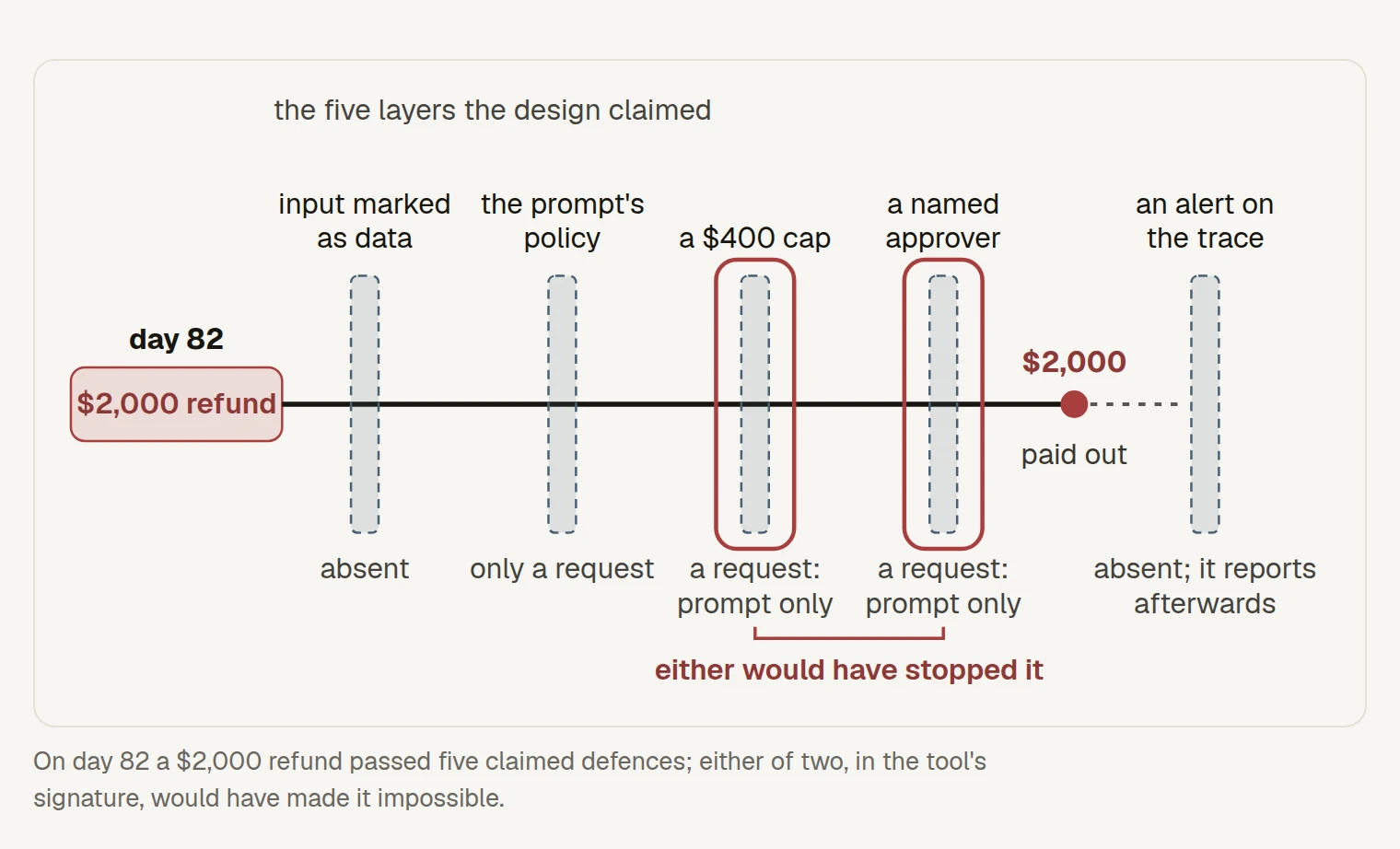
One question runs the whole incident loop: **which enforced control, if it had been present, would
have made this impossible?** On day 82 SkyWays' agent issued a $2,000 refund that was not owed. The
postmortem found five layers of defence claimed and none enforced; two lived only in the prompt. What
left the room was a typed $400 cap, a confirmation token, refunds dropped one autonomy level until a
fourteen-day shadow run re-earned it, and six new golden cases. **It closes when a brief for the next
P0 exists, with an owner.**
### Step 5 · Give governance to the sponsor
Governance is the only loop the delivery roles do not own: a minimum set of artefacts at each
hand-off, hard gates that halt and soft gates that do not, one accountable name per artefact, and
**two numbers reported together every cycle** (the saving and the spend). It is the loop most often
absent, because nobody downstream is waiting for it.
## Where you'll use it
- **In a quarterly health check**: mark each of the eight closed, open or absent, with the evidence.
- **After every bill anomaly and every incident**: ask which artefact at the near end should change.
- **When onboarding a sponsor**: the governance loop is the part of the lifecycle that is theirs.
## Why it matters
A programme that runs the phases but not the loops ships once and then drifts. The two loops that
close backwards are what turn a project into a practice: the first time a bill changes a design, or
an incident changes a frame, the team stops paying for the same lesson twice.
## Try it
After an incident, a team's postmortem lists: *"retrain staff on refund policy; add a note to the
prompt; review refund logs monthly"*. **Is the incident loop closed?**
Show the answer
**No: it is absent, dressed as open.** None of the three actions is an enforced control: training
and a prompt note are both requests, and a monthly log review finds the next incident after it has
happened. The loop closes when a control that makes the incident impossible exists (a typed cap in
the refund tool with a test beside it, say) and a brief for the next P0 has an owner and a date.