# The Evidence Pack: What Must Exist Before Each AI Hand-off
Thirty documents, owed across four hand-offs, and the check that a document exists is the least important check you can run on it.
7 min read · Intermediate · Lesson 9 of 9 in Agentic PDLC fundamentals · Updated 2026-10-03 · By Akash Das
Canonical: https://akash-coded.github.io/aws-bedrock-agentcore-strands/learn/the-evidence-pack/
> **In short.** The evidence pack is the minimum set of artefacts owed at each hand-off of the
> agentic PDLC, kept on one dated index. Owed means the next phase would have to invent it otherwise.
> The pack is checked not only for whether each artefact exists and is current, but for whether each
> control it describes is **enforced in code or only written down**.
**In this lesson** you'll learn:
- what makes an artefact *owed* rather than merely useful;
- the minimum set at each of the four hand-offs, and the test for each;
- why "enforced, or only written?" is the most important column in the pack.
## Sound familiar?
- An auditor asks why the refund cap is $400, and the answer is in somebody's memory.
- A new engineer spends the first week asking questions the design documents should have answered.
- Every document exists, every checkbox is ticked, and the control it describes still failed in production.
The pack exists for all three, and the third is why existence is the weakest thing you can check.
## What is the evidence pack?
The evidence pack is the **minimum artefact set** of the [agentic PDLC](https://akash-coded.github.io/aws-bedrock-agentcore-strands/learn/what-is-the-agentic-pdlc/):
the few documents owed at each hand-off between phases. Together they are what you show an auditor,
a new team member, or yourself in six months when nobody remembers why the cap is what it is.
An artefact is **owed** when the next phase cannot start properly without it: the test is not whether
someone wants it, but whether the next phase would otherwise have to invent it. Everything else is
optional: keep it if somebody reads it, delete it if not.

## Build the pack, step by step
### Step 1 · Sort every document into one of four states
| State | Means | What the next phase does |
| --- | --- | --- |
| **Owed and present** | It exists, it is current, and the receiving owner has read it | Starts |
| **Owed and stale** | It exists, and the system has moved past it | Starts, then builds on a fiction |
| **Owed and absent** | It does not exist | Invents it, silently and plausibly |
| **Not owed** | Useful, but nobody downstream is blocked | Keep it if read; delete it if not |
The dangerous state is the second one. A stale artefact passes every check that asks whether a
document exists.
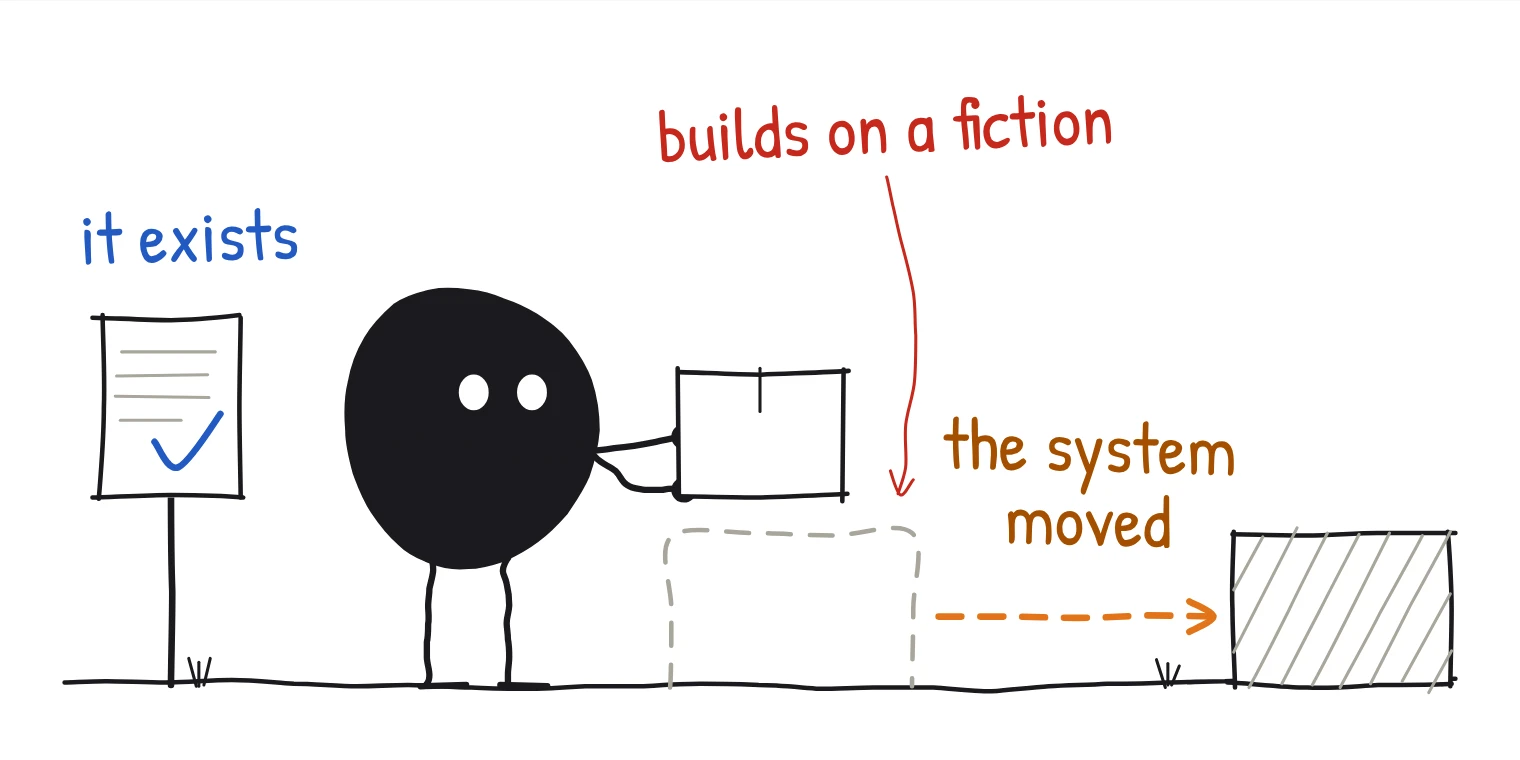
*A stale document passes every check that asks whether it exists. The next phase starts, then builds on a fiction.*
### Step 2 · Check each hand-off against its test
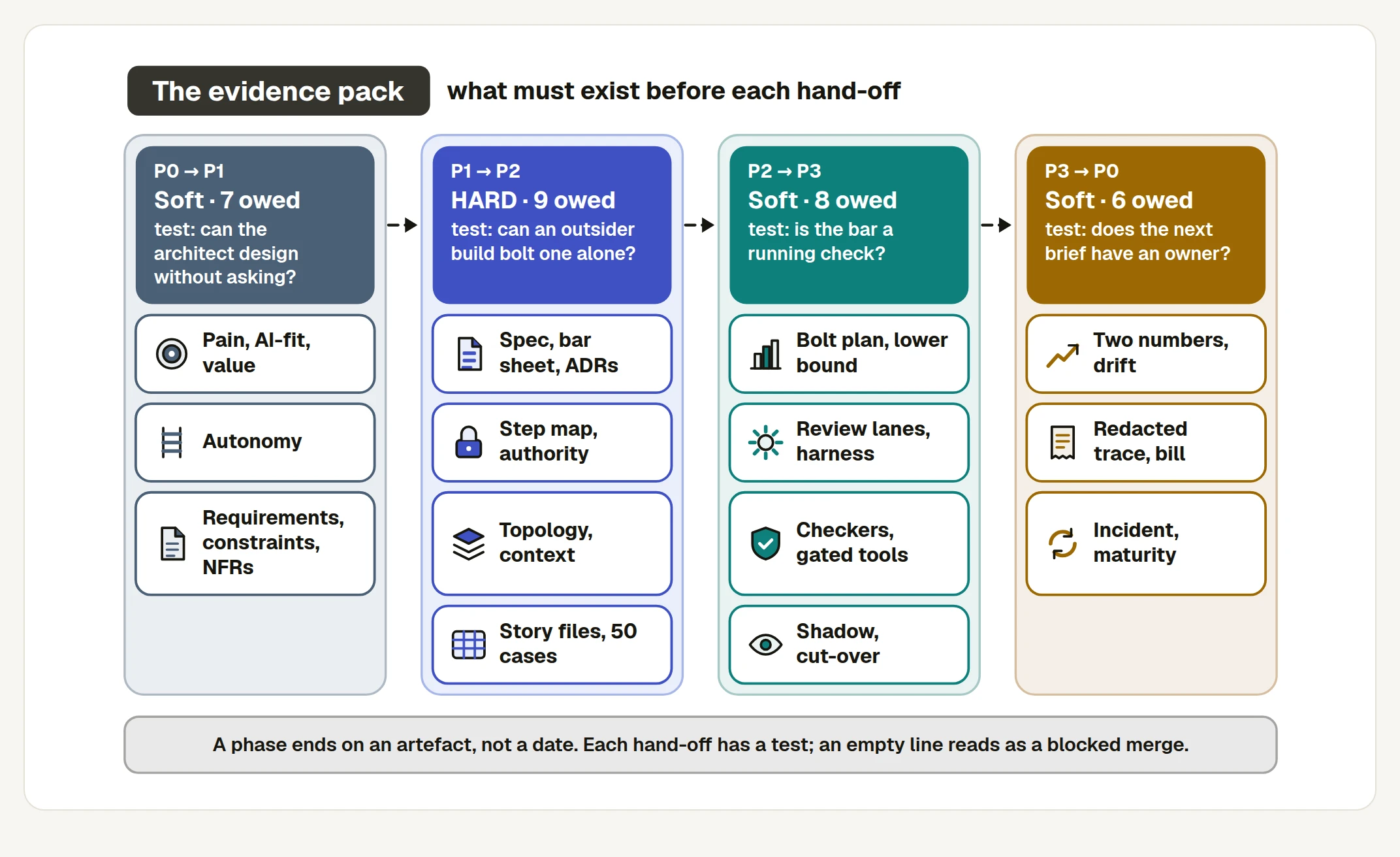
Each hand-off has a one-line test, drawn in the map at the top, which also counts what each one owes: seven
artefacts at P0 → P1, nine at the hard gate, eight at P2 → P3 and six at P3 → P0. The two tests that matter
most:
- **P0 → P1.** Can the architect start designing without asking the product manager a question?
- **P1 → P2, the hard gate.** Hand the pack to an engineer who was not in the room. If they can build
the first bolt without a conversation, the gate is passable.
### Step 3 · Add the column nobody adds: enforced, or only written?
For every control an artefact describes, record where it *should* live and run a command that proves
it does. A cap belongs in a tool signature; an approval rule belongs in the tool and the access
policy; "the bar blocks the merge" belongs in branch protection.
| Control | Should live in | The check you run | Result |
| --- | --- | --- | --- |
| $400 refund cap | The refund tool's signature | `rg "max=400" src/tools/` | 0 hits, **NOT ENFORCED** |
| Named approver above the cap | The tool, and the access policy | `rg "approver" src/ infra/` | prompt only, **NOT ENFORCED** |
| The bar blocks the merge | A required status check | read the branch protection rule | required, enforced |
Any control found only in a prompt, a runbook or a document is not enforced, and the pack says so in
capitals. SkyWays crossed its hard gate with the authority budget written and not enforced; on day 82
a $2,000 refund went out that the budget forbade. This single column is the difference between a gate
and a formality.
### Step 4 · Date every artefact
Give every row a version and a last-changed date, and ask at each review whether the system has moved
past it. A spec at version 3 while the code is on the behaviour of version 7 is an owed artefact in
the stale state, and it is the one a new engineer will trust.
### Step 5 · Keep it on one index page
The pack is one page: one row per owed artefact, with its hand-off, owner, link, version, last-changed
date, whether it is current, and who has read it. Everything else is a link from it. A pack that is a
folder of documents is a pack nobody reviews.
## Where you'll use it
- **At every hand-off**, as the checklist the receiving owner signs.
- **Before an audit or a regulator's question**, as the answer that does not depend on who is in the room.
- **When onboarding** an engineer or a new agent session, as the reading list that lets them start.
## Why it matters
The pack is the difference between a decision that was **made** and a decision that was **kept**. Most
of what goes wrong in an agentic system was decided correctly somewhere (the cap, the approver, the
bar) and then never enforced, or enforced once and allowed to go stale.
## Try it
At the end of P1 the authority budget says refunds over $400 need a named approver. The system prompt
says *"never refund over $400 without approval"*. A search of the tools folder for the cap returns
nothing. **Is the P1 → P2 gate passable?**
Show the answer
**No.** The authority budget is owed and present, but the control it describes is written only: it
lives in a prompt, which a model can be talked past. The hard gate fails on the enforcement column.
The fix is a typed, bounded parameter in the refund tool with two tests beside it; or, if the
programme genuinely cannot wait, a written waiver that names this gap, its blast radius and the date
it will close.