# What Is the Agentic PDLC? The P0 to P3 Framework Explained
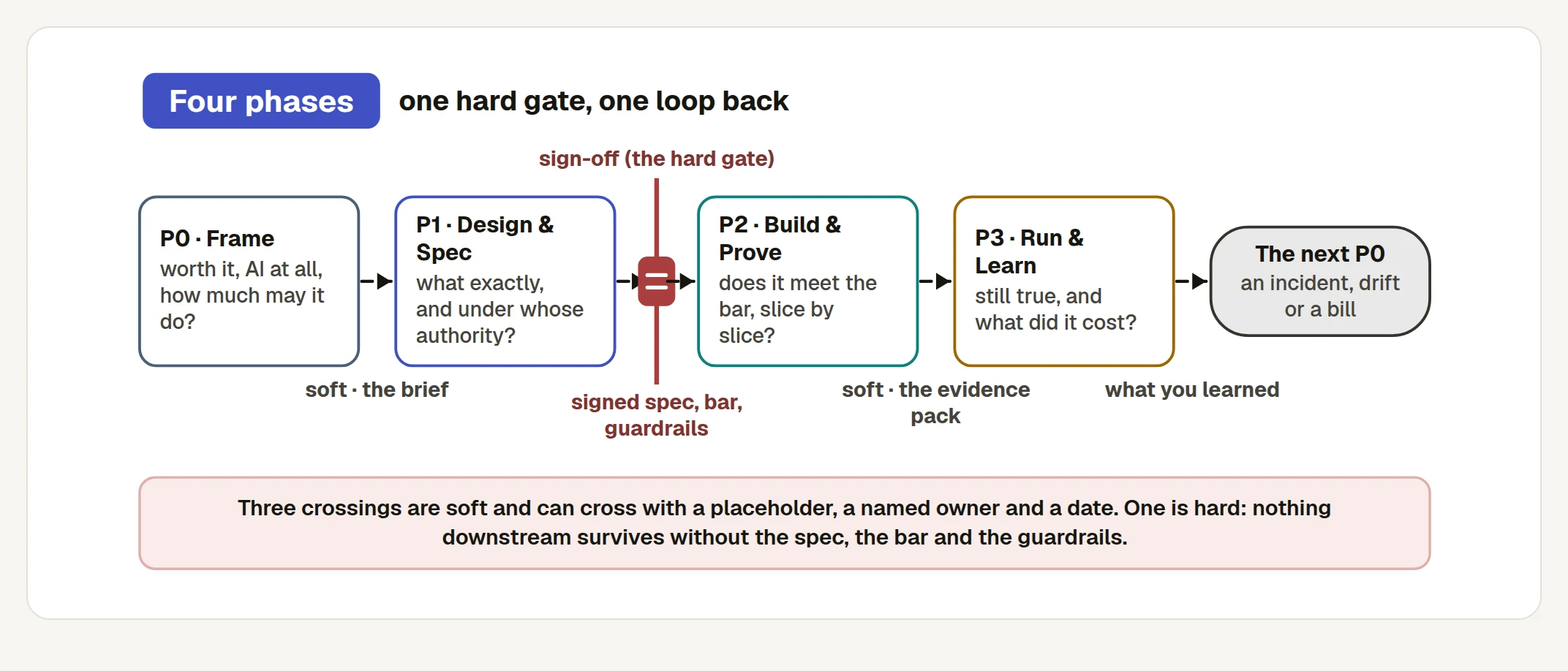
Four phases, one hard gate and a line that comes back. The whole framework in one sitting, with the reason behind each piece.
10 min read · Beginner · Lesson 1 of 2 in Getting started · Updated 2026-10-03 · By Akash Das
Canonical: https://akash-coded.github.io/aws-bedrock-agentcore-strands/learn/what-is-the-agentic-pdlc/
> **In short.** The agentic PDLC is a product lifecycle for software in which an AI model makes some of the
> decisions, run in four phases. **P0 Frame** decides whether it is worth building and how much the
> machine may do, and **P1 Design & Spec** writes it down so a machine can build it. **P2 Build &
> Prove** builds it in slices against a measured bar, and **P3 Run & Learn** watches it in production
> until what you learn becomes the next P0.
**In this lesson** you'll learn:
- what each of the four phases decides, and the condition that ends it;
- why only one of the four hand-offs is a hard gate;
- how the framework sits beside AWS AI-DLC, the BMAD Method, spec-driven development, AIDD and Scrum.
## Sound familiar?
- The demo worked in week two. It is week eleven, and nobody can say whether it is good enough to launch.
- The spec was signed, and every engineer still asked the same three questions in their first week.
- The bill arrived at four times the estimate with traffic flat, and it went to finance instead of back to the design.
Each of those is a phase that ended on a date instead of on evidence. That is the specific failure
the agentic PDLC is built to prevent.
## What is the agentic PDLC?
A **product development lifecycle (PDLC)** is the path a product takes from an idea to something
people rely on. The **agentic PDLC** is that path redrawn for products in which a large language
model does part of the work: drafts the reply, chooses the tool, issues the refund.
The redraw is needed because a model breaks an assumption every older lifecycle made: that software
does the same thing every time. A model is right most of the time, fluent all of the time, and wrong
without raising an error. So the lifecycle has to answer three questions a waterfall plan or a
Scrum board never asked: **how right is right enough, who decided that, and how will we know when it
stops being true?**
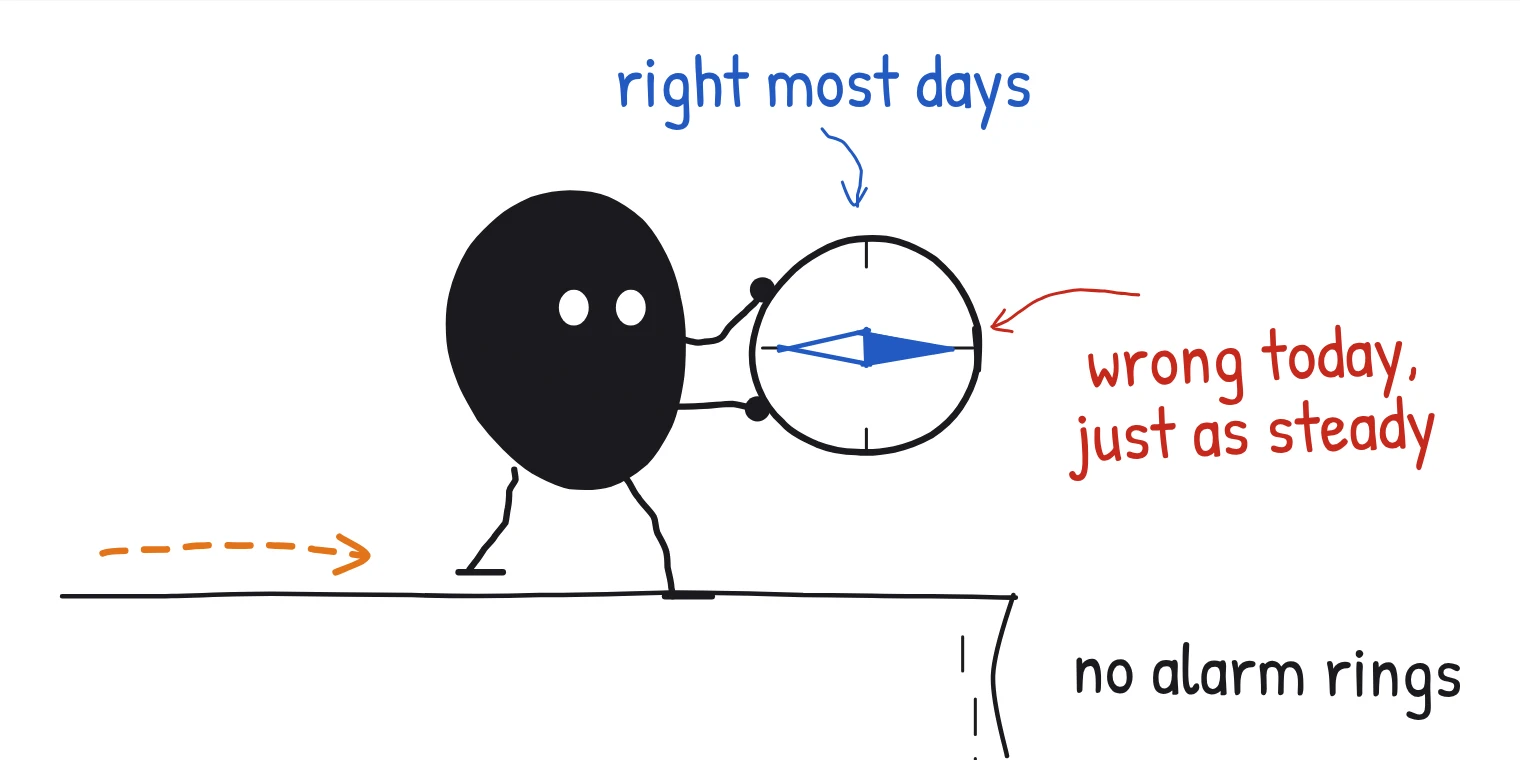
*A model is right most of the time and sounds sure all of the time. When it is wrong, nothing shakes and no alarm rings.*
It answers them with four phases. They are numbered P0 to P3 so they sort in order, and so nobody
mistakes them for one vendor's stage names.
## The four phases, step by step
| | Phase | The question it answers | Accountable | It ends when |
| --- | --- | --- | --- | --- |
| **P0** | Frame | Is it worth doing, is it AI at all, and how much may the machine do? | Product manager | The pain is a measurement and the AI-fit verdict is recorded |
| **P1** | Design & Spec | What exactly is being built, and under whose authority? | Solution architect | The spec, the bar and the guardrails are signed |
| **P2** | Build & Prove | Does it meet the bar, slice by slice? | Engineering lead | The golden set clears the bar and a shadow run agrees |
| **P3** | Run & Learn | Is it still doing what we launched, and what did it cost? | Sponsor | Two numbers are reported and the next P0 brief exists |
### Step 1 · P0 Frame: decide before anything is built
P0 turns a request into a measurement: "customers hate waiting" becomes a count, a cost and a link
to the evidence a sceptic can open. It then asks whether the job needs a model at all (many do not) and sets how much the machine may do on its own, one action at a time. It ends when the pain has a
number and the AI-fit verdict, including what was rejected, is written down.
[P0 Frame in depth](https://akash-coded.github.io/aws-bedrock-agentcore-strands/learn/p0-frame/).
### Step 2 · P1 Design & Spec: write it so a machine can build it
P1 writes down what will be built precisely enough that a coding agent, or an engineer who was not
in the room, can build it without asking. That means acceptance criteria in a checkable syntax, an
**acceptance bar for each slice** derived from what a mistake costs, and the guardrails: what the
agent may do, what needs a person, and which limits live in code rather than in the prompt. It ends
when all three are signed. [P1 in depth](https://akash-coded.github.io/aws-bedrock-agentcore-strands/learn/p1-design-and-spec/).
### Step 3 · P2 Build & Prove: build in slices, prove each one
P2 builds in **bolts**: cycles of hours or days, one risk each, starting with a walking skeleton that
runs end to end. Every slice is measured against its bar on a golden set, and a merge that drops a
slice below its bar is blocked. P2 closes with a **shadow run**, in which the agent handles live
traffic without acting and its answers are compared with what people actually did.
[P2 in depth](https://akash-coded.github.io/aws-bedrock-agentcore-strands/learn/p2-build-and-prove/).
### Step 4 · P3 Run & Learn: keep it true, and learn from it
P3 widens the live share gradually, watches the output mix for drift, and reports **two numbers on
one line**: what the feature saved and what it cost. An incident, a drift alert or a bill that leaves
its estimate does not end in a ticket; it ends in a brief for the next P0.
[P3 in depth](https://akash-coded.github.io/aws-bedrock-agentcore-strands/learn/p3-run-and-learn/).
## The one hard gate
Four hand-offs connect the phases, as the map at the top shows, and only one of them is hard.
A **soft** hand-off may cross with a placeholder, a named owner and a date, which keeps work moving
while a decision is still being measured. The **hard** one may not: nothing enters P2 until the
spec, the bar and the guardrails are signed. It is hard because it is the last point at which
changing your mind costs a document instead of a rewrite: a one-way door, where the others are
two-way. [Why the gate sits exactly there](https://akash-coded.github.io/aws-bedrock-agentcore-strands/learn/the-hard-gate/).
## How it fits beside AI-DLC, BMAD, spec-driven development, AIDD and Scrum
The agentic PDLC is a spine, not a rival method. The methods you have heard of each occupy part of it.
Scrum is not in the picture: it is a team process that runs inside P2, not a method with phases of its own.
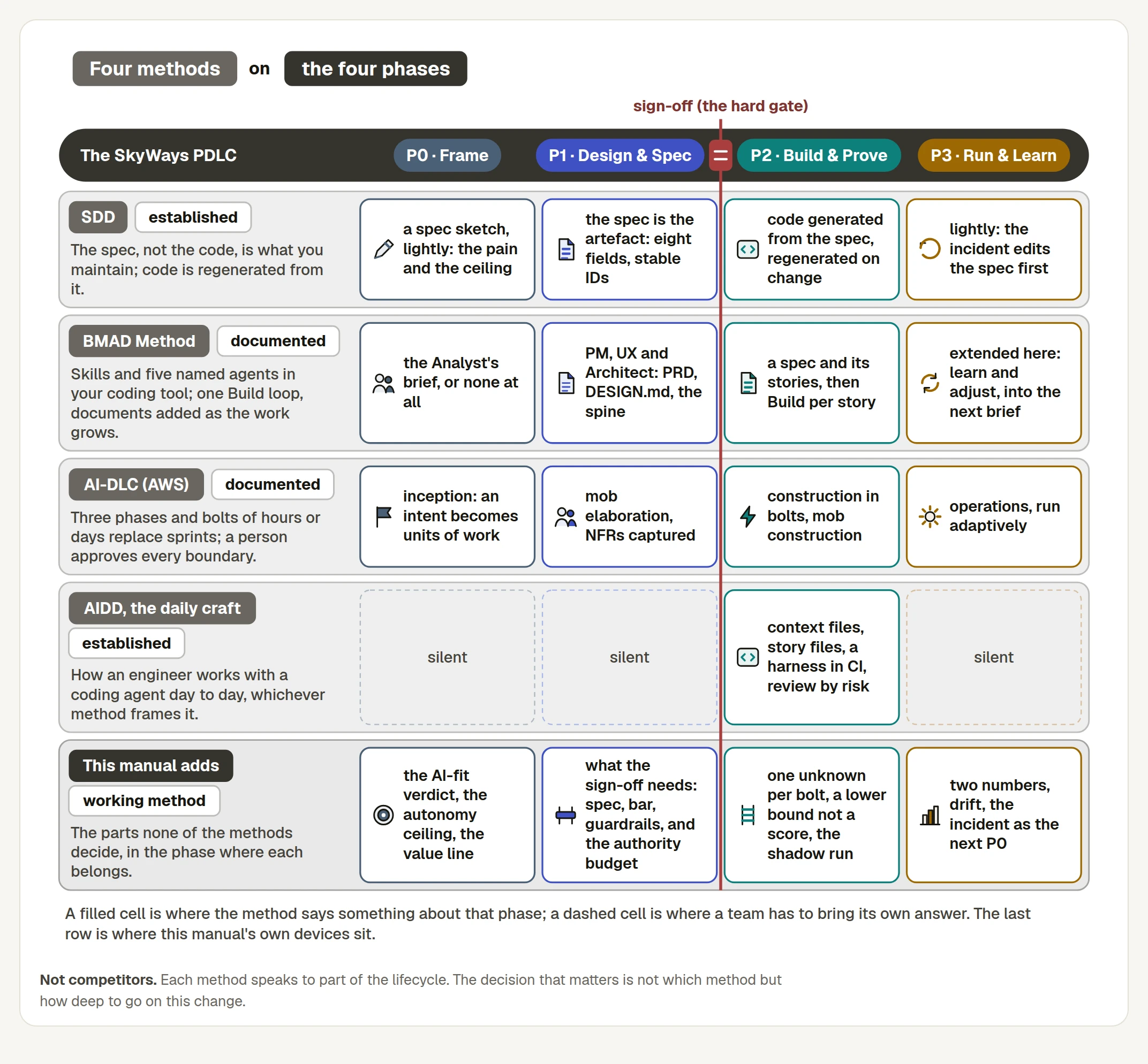
| Method | What it is | Where it sits |
| --- | --- | --- |
| **AWS AI-DLC** | AI proposes and people decide, across Inception, Construction and Operations, in bolts of hours or days | Inception ≈ P0 to P1 · Construction ≈ P2 · Operations ≈ P3 |
| **BMAD Method** | Skills and five named agents; one Build loop with a spec, stories and shared documents added as the work grows | Mostly P0 to P2 |
| **Spec-driven development** | The spec is the maintained artefact; code is generated from it, as in Kiro or GitHub Spec Kit | P1 and P2 |
| **AIDD** | AI-driven development, the everyday craft of building with coding agents: a context file, a story file per task, review by risk | Inside P2, whichever method frames it |
| **Scrum** | Time-boxed sprints over a backlog | Inside P2, where the sprint's unit becomes a bolt |
So the question worth arguing about is not *which method*, but *how deep this particular change
needs to go*. A one-line fix to a refund cap is tiny and deep; a large refactor of a read-only report
is big and shallow. [The named methods on one lifecycle](https://github.com/akash-coded/aws-bedrock-agentcore-strands/wiki/The-Agentic-PDLC#how-the-named-methods-sit-on-the-spine).
## Where you'll use it
- **On every change that involves a model**, at the depth the change needs. A one-line fix to a
refund cap runs all four phases in an afternoon; a new agent runs them over weeks.
- **Alongside the method you already use.** Stand-ups, backlogs and retrospectives carry on. What
changes is what each phase must leave behind before the next one starts.
- **By every role.** Each phase has one accountable owner, but every role works in every phase,
including the cells where a role should deliberately do nothing, which the
[by-role board](https://akash-coded.github.io/aws-bedrock-agentcore-strands/method/#by-role) draws.
## Why it matters
- **It makes "good enough" a number.** Each phase ends on evidence someone can open, so a launch is a
decision rather than a mood.
- **It moves the expensive decisions to where they are cheap.** Authority, the bar and the
guardrails are settled on paper, before the code exists to argue for itself.
- **It closes the loop.** P3 produces the next P0, so an incident or a bill changes the design
instead of the budget.
## Try it
A team at an insurer has a prototype agent that approves small claims. It demos well, and the
engineering lead wants to start building "for real" on Monday. The product manager has a measured
pain; the architect has a draft spec. **What must be true before the work can enter P2?**
1. The model and its temperature are chosen and written into the spec.
2. The spec, the acceptance bar for each slice and the guardrails are signed.
3. A sprint plan exists for the next six weeks.
4. The prototype is deployed to production behind a feature flag.
Show the answer
**2.** P1 → P2 is the one hard gate, and it opens on a signed spec, a bar per slice and the
guardrails. Option 1 is a known anti-pattern: fixing the model's knobs in a spec ties a requirement
to one vendor's settings, which belong to the build. Option 3 is a calendar, not evidence. Option 4
skips P2 altogether.